Table of Contents
- What Is Controlled Environment Farming?
- What Is Traditional Farming?
- Why Is Traditional Farming Challenging During Monsoon?
- Controlled Environment Farming vs Traditional Farming in Monsoon
- Why Controlled Environment Farming Can Be Better During Monsoon
- Is Hydroponic Farming Better Than Traditional Farming in Monsoon?
- Is Controlled Soil-Based Farming Also Effective in Monsoon?
- Which Crops Benefit from Controlled Farming During Monsoon?
- Is Traditional Farming Still Important?
- Controlled Environment Farming Is About Predictability
- How Nature Harvest Farms Approaches Monsoon Production
- Who Should Choose a Controlled-Environment Produce?
- Frequently Asked Questions
- Conclusion
India’s monsoon is essential for agriculture, but it can also create serious challenges for vegetable growers. Heavy rainfall, waterlogging, excessive humidity, soil erosion, nutrient loss, pest attacks, fungal diseases, and unpredictable weather can affect crop health, yield, and quality.
Traditional open-field farming remains important and suitable for many crops. However, when businesses require premium-quality vegetables, predictable harvests, and a reliable year-round supply, Controlled Environment Farming can provide greater stability during the rainy season.
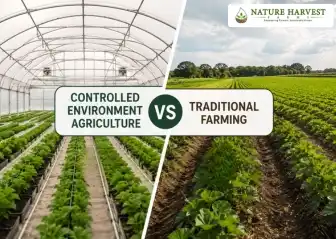
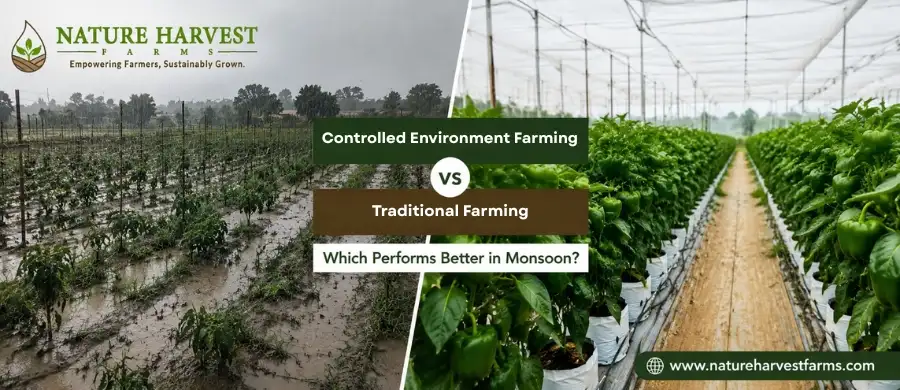
So, Controlled Environment Farming vs traditional farming: which is better in monsoon?
For high-value vegetables that require consistent quality and close crop management, Controlled Environment Agriculture generally offers better protection, predictability, and production control during the monsoon. Traditional farming may require lower initial infrastructure investment, but it remains considerably more dependent on rainfall, soil conditions, and changing weather.
At Nature Harvest Farms, we use modern Controlled Environment Agriculture practices, including hydroponic systems and controlled soil-based cultivation, to produce fresh vegetables for wholesalers, restaurants, hotels, caterers, retailers, and institutional buyers.
Controlled Environment Farming is generally more reliable than traditional open-field farming during monsoon because it allows growers to manage water, nutrients, humidity, crop exposure, and growing conditions more precisely.
Traditional farming depends heavily on natural weather and field conditions. Controlled farming does not eliminate every agricultural risk, but it can reduce direct exposure to excessive rain, waterlogging, soil erosion, and sudden weather changes.
What Is Controlled Environment Farming?
Controlled Environment Farming, also known as Controlled Environment Agriculture or CEA, is a modern farming method in which crops are grown under protected and closely monitored conditions.
Depending on the crop, the farming system may include:
- Hydroponic farming
- Controlled soil-based cultivation
- Polyhouse farming
- Greenhouse cultivation
- Protected cultivation
- Precision irrigation
- Climate and humidity monitoring
- Nutrient management
- Crop health monitoring
The objective is not to disconnect farming from nature. Instead, it is to create a more stable growing environment in which water, nutrients, temperature, humidity, ventilation, and crop protection can be managed according to the plant’s needs.
Nature Harvest Farms follows a CEA model that includes both hydroponic systems and controlled soil-based cultivation. The growing method is selected according to the crop, required quality, and sustainability goals.
What Is Traditional Farming?
Traditional farming generally refers to crops grown directly in open fields under natural environmental conditions.
Farmers depend on factors such as:
- Natural rainfall
- Outdoor temperature
- Soil fertility
- Local humidity
- Seasonal cycles
- Groundwater or canal irrigation
- Natural sunlight
- Open-field pest management
Traditional agriculture is essential for large-scale production of crops such as rice, wheat, cotton, maize, pulses, and oilseeds. It can also be suitable for many vegetables when soil, climate, water, and market conditions are favourable.
However, because crops are directly exposed to the environment, open-field production can become more difficult to manage during periods of excessive rainfall or irregular monsoon conditions.
Why Is Traditional Farming Challenging During Monsoon?
The monsoon is not automatically harmful to farming. Adequate rainfall supports crop establishment, irrigation, groundwater recharge, and agricultural productivity.
The challenge arises when rainfall is excessive, irregular, delayed, or poorly distributed. Monsoon conditions can vary considerably between locations and across the season. For example, some agricultural regions may experience delayed rainfall while others face heavy downpours or prolonged wet conditions.
In 2026, delayed monsoon progress initially affected summer crop planting in parts of India before rainfall revived. This demonstrates how strongly open-field agriculture can depend on the timing and distribution of seasonal rain.
1. Waterlogging and Poor Root Health
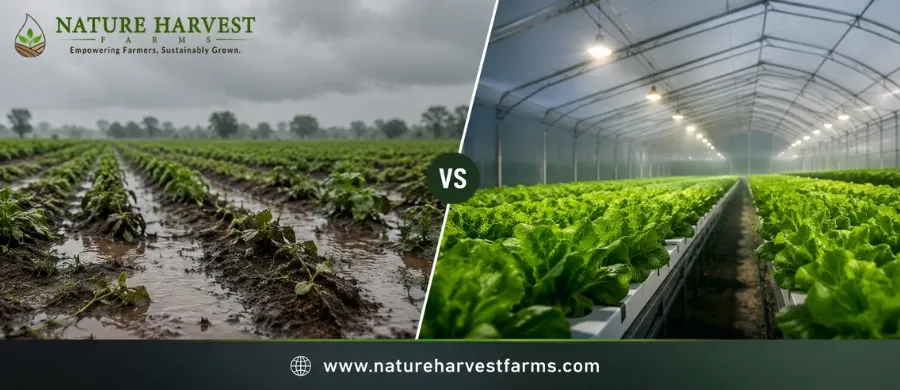
Heavy rainfall can saturate open fields and reduce the amount of oxygen available around crop roots.
When drainage is inadequate, waterlogging may:
- Restrict root respiration
- Slow plant growth
- Increase root-related diseases
- Reduce nutrient absorption
- Damage young plants
- Cause crop failure in severely affected areas
In Controlled Environment Farming, irrigation can be scheduled according to crop demand instead of depending entirely on rainfall.
2. Soil Erosion
Intense rain can remove fertile topsoil, particularly from exposed or sloping agricultural land.
Soil erosion may carry away:
- Organic matter
- Essential nutrients
- Recently applied fertilizers
- Seeds and young plants
- Beneficial soil microorganisms
Protected farming structures help reduce direct rain impact on the growing area, making crop and nutrient management more predictable.
3. Nutrient Leaching
Continuous or excessive rain can move nutrients below the root zone or carry them away through runoff.
This may lead to:
- Nutrient deficiencies
- Uneven crop growth
- Additional fertilizer requirements
- Higher production costs
- Reduced crop quality
Hydroponic and precision-farming systems allow nutrients to be supplied in controlled quantities based on plant requirements.
4. Higher Humidity and Disease Pressure
The rainy season often brings prolonged moisture and high humidity. These conditions can favour the development and spread of certain fungal and bacterial crop diseases.
Open-field plants may remain wet for long periods after rainfall, especially where airflow and drainage are poor.
Controlled farming allows growers to manage ventilation, plant spacing, irrigation timing, and crop monitoring more systematically. However, protected farms must also be managed carefully because humidity can build up inside an inadequately ventilated structure.
5. Increased Pest Exposure
Monsoon conditions can influence the activity and reproduction of many agricultural pests.
In open fields, crops are directly exposed to:
- Flying insects
- Soil-borne pests
- Pest movement from nearby fields
- Contaminated rain splash
- Weeds that act as pest hosts
Protected cultivation can reduce direct crop exposure, although regular monitoring and integrated pest management remain necessary.
6. Irregular Crop Quality
Hotels, restaurants, retailers, caterers, and wholesalers frequently require vegetables with consistent:
- Size
- Colour
- Shape
- Freshness
- Taste
- Texture
- Shelf life
Heavy rain and fluctuating field conditions can produce uneven growth and variable crop quality.
Controlled Environment Agriculture makes it easier to maintain consistent growing conditions across multiple crop batches.
7. Unpredictable Harvesting and Supply
Heavy rain can affect harvesting, transportation, labour availability, field access, and delivery schedules.
Even when the crop survives, muddy fields and damaged rural roads may delay collection or distribution.
This creates supply-chain challenges for businesses that need vegetables on a regular schedule.
Controlled Environment Farming vs Traditional Farming in Monsoon
| Comparison Factor | Controlled Environment Farming | Traditional Open-Field Farming |
|---|---|---|
| Rain exposure | Crops receive protection from direct heavy rainfall | Crops are directly exposed |
| Water management | Irrigation can be measured and controlled | Influenced by rainfall and field drainage |
| Nutrient management | More precise and crop-specific | Nutrients may be lost through runoff or leaching |
| Soil erosion | Lower direct rainfall impact within protected structures | Higher risk during intense rain |
| Humidity management | Can be monitored through ventilation and farm management | Determined primarily by outdoor weather |
| Pest exposure | Reduced physical exposure in properly managed structures | Greater exposure to surrounding fields and insects |
| Disease monitoring | Easier to monitor crops closely | Larger open fields can be harder to supervise |
| Crop consistency | More uniform under stable growing conditions | May vary with weather and soil conditions |
| Harvest scheduling | More predictable | More dependent on seasonal conditions |
| Initial investment | Generally higher | Generally lower |
| Technical knowledge | Requires trained management | Familiar and widely practised |
| Supply reliability | Better suited to planned year-round supply | May fluctuate according to season |
Why Controlled Environment Farming Can Be Better During Monsoon
1. Protection from Direct Rainfall
One of the main advantages of protected cultivation during monsoon is that plants are not continuously exposed to heavy rain.
Protected structures can help prevent:
- Rain damage to leaves and fruits
- Excess water around roots
- Soil splash on produce
- Physical injury to delicate crops
- Sudden changes in growing conditions
This is particularly valuable for premium vegetables whose appearance directly affects market value.
2. Precise Water Management
Traditional farming may receive more rain than the crop can use during monsoon.
Controlled farming allows water to be supplied based on:
- Crop stage
- Root-zone condition
- Temperature
- Humidity
- Growing medium
- Plant water demand
Hydroponic farming can provide even greater control because water and nutrients are delivered directly to the root zone through a managed system.
3. Better Nutrient Control
In open fields, heavy rainfall can dilute, displace, or wash away nutrients.
In Controlled Environment Agriculture, nutrient delivery can be monitored and adjusted more precisely. This helps plants receive balanced nutrition throughout their growth cycle.
Better nutrient control can support:
- Uniform plant development
- Improved fruit formation
- Consistent crop quality
- Reduced input waste
- Predictable harvesting
4. More Stable Growing Conditions
CEA helps growers reduce the impact of external weather changes.
Although protected farms cannot control every natural variable, they provide greater control over important conditions such as:
- Irrigation
- Ventilation
- Crop spacing
- Nutrients
- Root-zone moisture
- Pest entry
- Plant support
- Harvest timing
ICAR research describes protected cultivation as a method of growing crops under structures that provide a suitable microclimate and reduce environmental stress. It can support year-round production and improve opportunities for growing high-value vegetables despite unpredictable weather.
5. Reduced Risk of Soil Erosion
Controlled soil-based farming protects the cultivation area from direct exposure to intense rain.
This helps preserve:
- Soil structure
- Organic matter
- Nutrient availability
- Root-zone stability
- Growing beds
Hydroponic systems avoid traditional field-soil erosion because plants are cultivated using managed nutrient and growing systems rather than exposed open-field soil.
6. Closer Crop Monitoring
Crops grown in controlled environments are generally organised into planned growing units.
This makes it easier for farm teams to:
- Inspect plants regularly
- Identify early signs of stress
- Detect pests and diseases
- Remove affected plant material
- Monitor irrigation
- Record crop performance
- Maintain hygiene protocols
Early detection can prevent a small crop issue from spreading through an entire growing unit.
7. More Consistent Vegetable Quality
Controlled growing conditions can support more uniform:
- Colour
- Shape
- Size
- Texture
- Taste
- Freshness
- Shelf life
Nature Harvest Farms focuses on consistent quality and predictable supply for B2B buyers. Its produce portfolio includes capsicum, lettuce, English cucumber, and cherry tomatoes grown under controlled farming practices.
8. Reliable Supply for B2B Buyers
Restaurants, hotels, wholesalers, retailers, caterers, and institutional kitchens cannot always change their menus or purchasing requirements because of bad weather.
They need a farming partner that can provide:
- Planned harvests
- Consistent quantities
- Repeatable quality
- Fresh delivery
- Scalable supply
- Clear communication
Because CEA is less dependent on direct rainfall, it is better suited to organised and predictable vegetable supply during the monsoon.
Is Hydroponic Farming Better Than Traditional Farming in Monsoon?
For many leafy vegetables and high-value crops, hydroponic farming can provide important advantages during monsoon.
Hydroponic systems deliver water and dissolved nutrients directly to plant roots. This reduces dependence on field soil and provides closer control over crop nutrition and moisture.
Key monsoon advantages include:
- No open-field soil waterlogging
- Reduced soil erosion
- Controlled nutrient delivery
- Less nutrient leaching
- More precise irrigation
- Organised crop monitoring
- Improved production planning
- Reduced dependence on natural rainfall
However, hydroponic farming requires proper infrastructure, technical knowledge, water-quality management, reliable power, system maintenance, hygiene, and regular monitoring.
Therefore, hydroponics is not simply a “set and forget” farming method. Its success depends on disciplined management.
Is Controlled Soil-Based Farming Also Effective in Monsoon?
Yes. Controlled Environment Agriculture does not always mean hydroponics.
In controlled soil-based cultivation, plants grow in soil or managed growing beds inside a protected structure. This approach combines natural soil cultivation with improved protection and environmental management.
Potential benefits include:
- Protection from direct heavy rain
- Better drainage management
- Reduced soil erosion
- Improved crop monitoring
- More stable growing conditions
- Lower direct exposure to pests
- Better-quality harvesting
- Greater consistency than open-field cultivation
At Nature Harvest Farms, the cultivation method is selected according to the crop, quality requirements, and sustainability objectives rather than using one system for every vegetable.
Which Crops Benefit from Controlled Farming During Monsoon?
Controlled Environment Farming is particularly useful for vegetables that are sensitive to excess moisture, inconsistent nutrition, disease pressure, or cosmetic damage.
Examples include:
Coloured Capsicum
Coloured capsicum requires careful management of moisture, nutrition, temperature, plant support, and fruit development.
Heavy rainfall and highly variable open-field conditions can affect fruit size, colour, shape, and quality. Protected cultivation helps growers maintain more consistent conditions throughout the crop cycle.
English Cucumber
English cucumber requires regular irrigation, balanced nutrition, training, pruning, and close crop monitoring.
Controlled cultivation helps protect the crop from direct rain while supporting uniform fruit development and planned harvesting.
Lettuce and Leafy Greens
Leafy greens can be sensitive to soil splash, excessive moisture, contamination, and physical damage.
Hydroponic cultivation provides a cleaner and more controlled production system for many leafy vegetables.
Cherry Tomatoes
Cherry tomatoes benefit from controlled water, nutrients, ventilation, plant support, and disease monitoring.
Protection from direct monsoon rain can help reduce fruit splitting and crop damage associated with sudden changes in moisture.
Is Traditional Farming Still Important?
Yes. Controlled farming should not be presented as a complete replacement for traditional agriculture.
Traditional open-field farming remains important because it:
- Supports large-scale food production
- Requires less protected infrastructure
- Is accessible to a wider number of farmers
- Works effectively for many regional crops
- Uses established farming knowledge
- Can be economical under favourable conditions
- Supports rural livelihoods across India
The better farming method depends on:
- Crop type
- Market price
- Local climate
- Soil condition
- Available land
- Water availability
- Required production volume
- Buyer expectations
- Farmer expertise
- Investment capacity
For bulk commodity crops, traditional farming may remain the practical choice. For high-value vegetables requiring consistent quality and predictable supply, Controlled Environment Farming often provides stronger advantages.
Controlled Environment Farming Is About Predictability
The biggest difference between CEA and traditional farming is not simply yield. It is predictability.
A well-managed controlled farm can plan:
- When crops are planted
- How much water they receive
- Which nutrients they require
- When they are likely to mature
- How frequently they can be harvested
- What quality buyers can expect
- How much produce may be available
This predictability is highly valuable for commercial buyers.
When hotels, restaurants, wholesalers, and retailers know what quality and quantity they can receive, they can manage purchasing, menus, inventory, and customer expectations more effectively.
How Nature Harvest Farms Approaches Monsoon Production
Nature Harvest Farms is a technology-driven agribusiness that uses hydroponic and Controlled Environment Farming practices to grow premium, sustainably produced vegetables.
Our approach focuses on:
- Controlled crop production
- Efficient resource management
- Precision irrigation
- Crop-specific cultivation methods
- Consistent quality
- Hygienic growing practices
- Reliable year-round supply
- Farmer empowerment
- Responsible agricultural growth
- B2B market requirements
We work to reduce dependence on unpredictable seasonal conditions while helping farmers use modern infrastructure, training, technology, and market connections.
Nature Harvest Farms serves wholesale, HoReCa, retail, catering, and institutional buyers that require fresh produce with dependable quality and availability.
Who Should Choose a Controlled-Environment Produce?
Controlled-environment vegetables can be especially beneficial for:
Hotels and Restaurants
Hospitality businesses require consistent size, flavour, freshness, and presentation for menu standardisation.
Wholesalers
Wholesale buyers need dependable volume, repeat orders, quality consistency, and planned supply.
Retailers and Supermarkets
Retailers benefit from vegetables with attractive appearance, uniform grading, freshness, and suitable shelf life.
Caterers
Catering businesses need predictable quantities for events, institutional kitchens, and large food-service operations.
Food Processors
Processors require vegetables with standard characteristics to maintain consistency across finished products.
FAQs
Which farming method is better during monsoon?
Why is traditional farming risky during heavy rainfall?
Is hydroponic farming suitable for the rainy season?
Does Controlled Environment Farming completely prevent crop diseases?
Can Controlled Environment Farming produce vegetables throughout the year?
Is Controlled Environment Farming the same as hydroponic farming?
Is Controlled Environment Farming more expensive?
Which vegetables does Nature Harvest Farms grow?
Who can purchase vegetables from Nature Harvest Farms?
Why do businesses prefer controlled-environment vegetables?
Conclusion
When comparing Controlled Environment Farming vs traditional farming in monsoon, both systems have important roles in Indian agriculture. Traditional farming remains essential for large-scale crop production, while Controlled Environment Agriculture offers greater protection, precision, consistency, and supply reliability for high-value vegetables.
By combining hydroponics, controlled soil-based cultivation, efficient resource use, and modern farm management, Nature Harvest Farms delivers fresh produce with reduced dependence on unpredictable monsoon conditions. For businesses seeking consistent quality and dependable supply, controlled farming provides a practical and future-ready solution.