Table of Contents
- What Is Controlled Environment Agriculture (CEA)?
- What Is Traditional Farming?
- Why Exotic Vegetables Require Special Growing Conditions
- Controlled Environment Agriculture vs Traditional Farming: Key Differences
- Why Consumers Prefer Controlled Environment Grown Exotic Vegetables
- The Nature Harvest Farms Approach
- Which Farming Method Is Better for Exotic Vegetables?
- Conclusion
Exotic vegetables are rapidly becoming a preferred choice among health-conscious consumers, restaurants, hotels, supermarkets, and food enthusiasts across India. Vegetables such as colored capsicum, cucumber, lettuce, zucchini, cherry tomatoes, and other specialty crops are gaining popularity because of their nutritional value, freshness, appearance, and versatility in modern cuisine.
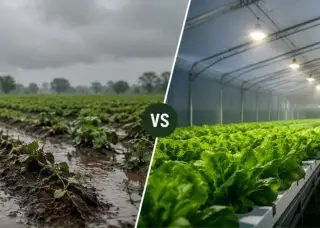
However, producing high-quality exotic vegetables consistently remains a challenge. Climate fluctuations, pests, diseases, irregular rainfall, and extreme temperatures often affect traditional farming methods. This is where Controlled Environment Agriculture (CEA) has emerged as a reliable solution for cultivating premium-quality exotic vegetables.
At Nature Harvest Farms, we specialize in growing exotic vegetables using soil-based Controlled Environment Farming, ensuring optimal growing conditions while maintaining natural cultivation practices. Unlike conventional open-field farming, Controlled Environment Agriculture enables farmers to manage environmental factors that directly influence crop quality, yield, and consistency.
In this article, we will compare Controlled Environment Agriculture vs Traditional Farming for Exotic Vegetables and explore why controlled environment farming is becoming the preferred choice for producing premium-quality exotic vegetables.
What Is Controlled Environment Agriculture (CEA)?
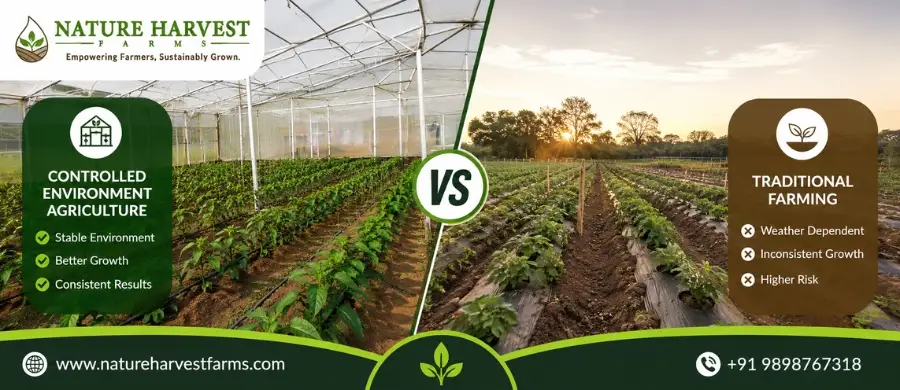
Controlled Environment Agriculture (CEA) is a farming method where environmental factors such as temperature, humidity, ventilation, light exposure, irrigation, and crop protection are carefully managed to create ideal growing conditions. This allows farmers to produce high-quality vegetables consistently throughout the year.
CEA does not necessarily mean soilless cultivation. At Nature Harvest Farms, exotic vegetables are cultivated in nutrient-rich soil under carefully monitored controlled environments to ensure natural growth and superior produce quality.
What Is Traditional Farming?
Traditional farming refers to open-field agriculture where crops are grown directly under natural environmental conditions. Farmers rely heavily on seasonal weather patterns, rainfall, sunlight, and natural soil conditions for crop production.
While traditional farming has been practiced successfully for centuries, it is often vulnerable to:
- Extreme temperatures
- Unpredictable rainfall
- Pest infestations
- Disease outbreaks
- Seasonal limitations
- Quality inconsistencies
These challenges become even more significant when growing delicate exotic vegetables that require stable growing conditions.
Why Exotic Vegetables Require Special Growing Conditions
Unlike conventional vegetables, many exotic crops are sensitive to environmental fluctuations.
Common exotic vegetables include:
- Red Capsicum
- Yellow Capsicum
- English Cucumber
- Lettuce
- Cherry Tomatoes
These vegetables require:
- Balanced temperature
- Proper humidity levels
- Adequate ventilation
- Consistent moisture
- Protection from excessive rainfall
- Reduced pest pressure
Even minor environmental stress can impact their size, color, taste, texture, and overall market value.
Controlled Environment Agriculture vs Traditional Farming: Key Differences
| Factor | Controlled Environment Agriculture | Traditional Farming |
|---|---|---|
| Climate Control | Managed conditions | Dependent on weather |
| Crop Consistency | Highly consistent | Varies by season |
| Quality Control | Better monitoring | Difficult to maintain |
| Pest Management | Reduced exposure | Higher pest risks |
| Crop Damage Risk | Lower | Higher |
| Seasonal Dependence | Less dependent | Highly dependent |
| Yield Stability | More predictable | Weather dependent |
| Product Appearance | Uniform and premium | Variable |
| Market Reliability | Year-round supply | Seasonal supply |
1. Better Crop Consistency
One of the biggest advantages of Controlled Environment Agriculture is consistency.
Restaurants, retailers, and consumers expect exotic vegetables to maintain:
- Uniform size
- Consistent color
- Better texture
- Reliable taste
Traditional farming often experiences fluctuations due to:
- Heat waves
- Heavy rainfall
- Wind damage
- Temperature swings
Controlled Environment Farms help maintain stable growing conditions, resulting in more consistent harvests.
At Nature Harvest Farms, consistency remains one of our primary goals when producing exotic vegetables for customers.
2. Superior Vegetable Quality
Controlled Environment Agriculture often produces higher-quality exotic vegetables because crops grow under carefully managed environmental conditions that minimize stress and support healthy development.
Consumers increasingly choose vegetables based on:
- Freshness
- Appearance
- Taste
- Shelf life
- Nutritional value
Controlled growing conditions help support all these factors.
Exotic vegetables cultivated under managed environments often exhibit:
- Richer colors
- Better shape
- Enhanced freshness
- Reduced physical damage
This makes them highly desirable in premium markets.
3. Reduced Environmental Stress
Weather unpredictability has become one of the biggest challenges in agriculture.
Traditional farming frequently faces:
- Unexpected rain
- Excessive heat
- Strong winds
- Temperature fluctuations
These factors can negatively affect crop growth.
Controlled Environment Agriculture helps minimize environmental stress by creating a stable growing atmosphere that supports healthy plant development throughout the crop cycle.
This is particularly important for sensitive exotic vegetables such as colored capsicum and cucumber.
4. Improved Pest and Disease Management
Controlled Environment Agriculture can help reduce pest and disease pressure by limiting crop exposure to external environmental factors and enabling proactive crop management.
Open-field crops remain exposed to numerous pest and disease threats.
Common challenges include:
- Insect infestations
- Fungal infections
- Bacterial diseases
- Crop contamination
A controlled growing environment allows farmers to monitor crops more closely and implement preventive measures more effectively.
This supports healthier plants and improved produce quality.
5. More Reliable Year-Round Production
One major limitation of traditional farming is seasonality.
Certain exotic vegetables may only thrive during specific months.
Controlled Environment Agriculture extends production capabilities by creating favorable growing conditions across different seasons.
Benefits include:
- Continuous supply
- Better planning
- Consistent availability
- Reliable market fulfillment
This is especially valuable for restaurants, food service providers, and retailers who require dependable access to fresh exotic vegetables.
6. Enhanced Freshness and Shelf Life
Freshness is a major purchasing factor for consumers.
Vegetables that experience less environmental stress often maintain:
- Better texture
- Longer shelf life
- Improved appearance
- Higher customer satisfaction
Controlled Environment Agriculture supports healthier crop development, helping vegetables retain quality after harvest.
At Nature Harvest Farms, maintaining freshness from cultivation to delivery remains a key focus.
7. Higher Market Value
Premium-quality exotic vegetables often command stronger market demand.
Buyers are willing to pay more for vegetables that offer:
- Consistent quality
- Attractive appearance
- Reliable supply
- Better freshness
Controlled Environment Agriculture helps producers meet these expectations more consistently than traditional farming methods.
This creates greater opportunities in:
- Retail markets
- Premium grocery stores
- Hotels
- Restaurants
- Catering businesses
8. Better Resource Management
Controlled Environment Farming allows farmers to monitor and manage growing conditions more efficiently.
This includes:
- Water management
- Crop monitoring
- Nutrient management
- Environmental control
Efficient resource utilization contributes to healthier crop production and improved farming outcomes.
Why Consumers Prefer Controlled Environment Grown Exotic Vegetables
Today’s consumers are increasingly informed about food quality.
They seek vegetables that are:
- Fresh
- Clean
- Nutritious
- Consistent
- Visually appealing
Controlled Environment Agriculture helps meet these expectations through careful cultivation practices and close crop monitoring.
This is one reason why premium grocery retailers and hospitality businesses often prefer vegetables grown in controlled environments.
The Nature Harvest Farms Approach
At Nature Harvest Farms, we combine the benefits of soil-based Controlled Environment Agriculture with responsible farming practices to cultivate premium exotic vegetables.
Our farming approach focuses on:
- Soil-based cultivation
- Controlled growing conditions
- Crop consistency
- Freshness preservation
- Quality-focused harvesting
- Sustainable farming practices
By maintaining favorable environmental conditions, we strive to deliver exotic vegetables that meet the expectations of modern consumers and businesses.
Our goal is not simply to grow vegetables but to consistently provide produce that offers superior freshness, appearance, and reliability.
Which Farming Method Is Better for Exotic Vegetables?
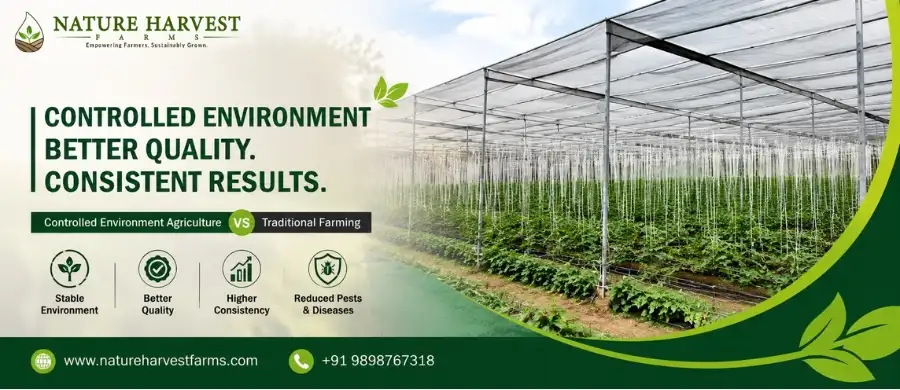
For exotic vegetables, Controlled Environment Agriculture generally offers better consistency, quality, crop protection, and year-round availability compared to traditional farming. Stable growing conditions help support healthier plant development and more reliable harvests.
While traditional farming continues to play a valuable role in food production, exotic vegetables often benefit significantly from controlled growing environments because of their sensitivity to climate variations.
Conclusion
As demand for premium exotic vegetables continues to grow across India, the need for reliable, high-quality production methods becomes increasingly important. While traditional farming remains a foundational agricultural practice, it often faces challenges from unpredictable weather and environmental stress.
Controlled Environment Agriculture provides a more stable and consistent approach for cultivating exotic vegetables such as colored capsicum, cucumber, lettuce, and specialty greens.
At Nature Harvest Farms, our soil-based Controlled Environment Farming practices allow us to focus on quality, consistency, freshness, and responsible cultivation. By carefully managing growing conditions, we are able to produce exotic vegetables that meet modern consumer expectations while supporting sustainable agricultural growth.
Whether you are a retailer, restaurant owner, wholesaler, or health-conscious consumer, choosing vegetables grown in a controlled environment can help ensure superior quality, reliable supply, and exceptional freshness throughout the year.