
Table of Contents
- Introduction: Why Greenhouses Matter in Modern Agriculture
- What Is a Greenhouse?
- Types of Greenhouses Used in India
- Comparison of Greenhouse Types
- Choosing the Right Greenhouse Type
- Role of Greenhouses in Controlled Environment Agriculture (CEA)
- How Nature Harvest Farms Uses Greenhouse Technology
- Future of Greenhouse Farming in India
- Conclusion: Greenhouses as the Foundation of Modern Farming
Introduction: Why Greenhouses Matter in Modern Agriculture
Agriculture in India is undergoing a major transformation. With increasing climate uncertainty, water scarcity, rising input costs, and the need for consistent crop quality, traditional open-field farming is no longer enough to meet modern demands.
This is where greenhouse farming plays a crucial role.
Greenhouses form the backbone of Controlled Environment Agriculture (CEA), a system that allows farmers to regulate temperature, humidity, light, and airflow to create ideal growing conditions for crops. By reducing dependency on external weather and improving resource efficiency, greenhouses enable year-round production, better yields, and higher-quality produce.
Among the most widely used greenhouse structures in India are:
- Fan Pad Greenhouse
- Polyhouse
- Net House
Each type serves a different purpose, crop requirement, and investment level. Understanding these greenhouse types is essential for farmers, agribusinesses, and stakeholders looking to adopt sustainable and scalable farming practices.
This guide explains all three greenhouse types in detail – how they work, their benefits, limitations, and where they are best used.
What Is a Greenhouse?
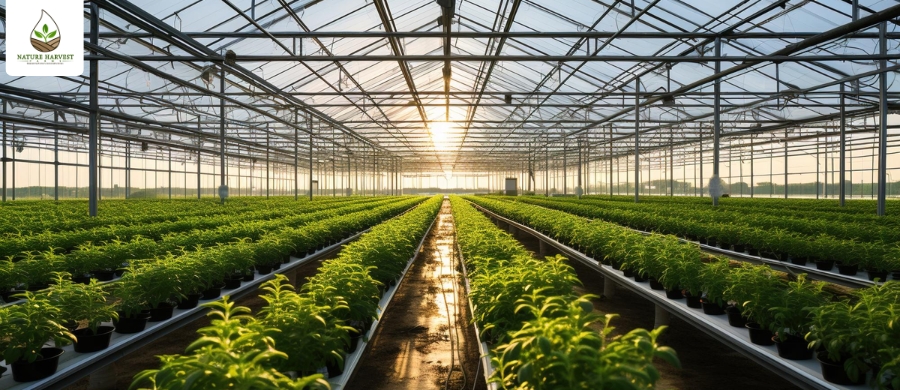
A greenhouse is a controlled structure designed to protect crops from external climatic variations while optimizing internal growing conditions. It uses transparent or semi-transparent materials to allow sunlight in while retaining heat and enabling environmental control.
In Controlled Environment Agriculture (CEA), greenhouses are enhanced with:
- Ventilation systems
- Cooling and heating mechanisms
- Humidity and temperature regulation
- Drip irrigation or fertigation systems
Greenhouses can be used for both soil-based cultivation and soilless systems like hydroponics, depending on crop requirements.
Types of Greenhouses Used in India
India’s diverse climate and farming needs have led to the adoption of different greenhouse structures. The most commonly used types are:
1. Fan Pad Greenhouse
2. Polyhouse
3. Net House
Each serves a unique role within modern farming systems.
1. Fan Pad Greenhouse
What Is a Fan Pad Greenhouse?
A Fan Pad Greenhouse is a highly controlled greenhouse structure that uses evaporative cooling to maintain optimal temperature and humidity levels. It consists of:
- Exhaust fans on one side
- Cooling pads (wet pads) on the opposite side
As hot air is pulled out by exhaust fans, fresh air passes through the wet cooling pads, lowering the temperature inside the greenhouse naturally.
This system is widely used in regions with high temperatures, making it ideal for many parts of India.
How Fan Pad Cooling Works
1. Water continuously flows over cooling pads
2. Hot outside air passes through wet pads
3. Air temperature drops due to evaporation
4. Exhaust fans pull cooled air across the greenhouse
5. Uniform cooling is achieved throughout the structure
This creates a stable microclimate for crops.
Crops Suitable for Fan Pad Greenhouses
Fan Pad Greenhouses are ideal for:
- Lettuce and leafy greens
- Capsicum (bell peppers)
- Cucumber
- Tomato (cherry and vine)
- Herbs like basil and parsley
These crops require precise temperature control and consistent growing conditions.
Benefits of Fan Pad Greenhouse
- Strong temperature control even in hot climates
- Enables year-round cultivation
- Improves crop uniformity and quality
- Reduces plant stress
- Ideal for high-value crops
Limitations of Fan Pad Greenhouse
- Higher initial investment
- Requires electricity and water supply
- Regular maintenance of fans and pads
- Skilled management needed
Despite higher costs, fan pad systems are preferred for commercial-scale, premium production.
2. Polyhouse (Naturally Ventilated Greenhouse)
What Is a Polyhouse?
A Polyhouse is a greenhouse structure covered with UV-stabilized polyethylene film. Unlike fan pad systems, polyhouses primarily rely on natural ventilation through side vents and roof openings.
Polyhouses are widely used in India due to their cost-effectiveness and adaptability.
How Polyhouse Ventilation Works
- Hot air rises and escapes through roof vents
- Cooler air enters through side openings
- Shade nets and curtains regulate sunlight
- Manual or semi-automatic controls manage airflow
Polyhouses create a moderately controlled environment suitable for many crops.
Crops Suitable for Polyhouse
Polyhouses are ideal for:
- Capsicum
- Tomato
- Cucumber
- Lettuce
- Herbs
- Flower crops
They support both soil-based and hydroponic cultivation.
Benefits of Polyhouse Farming
- Lower investment compared to fan pad greenhouses
- Suitable for Indian climatic conditions
- Reduced pest and disease exposure
- Improved yield compared to open-field farming
- Easy to scale and replicate
Limitations of Polyhouse
- Limited temperature control in extreme summers
- Dependent on external climate to some extent
- Less precise than fan pad systems
Polyhouses offer an excellent balance between cost, control, and productivity, making them popular among farmers transitioning to modern agriculture.
3. Net House
What Is a Net House?
A Net House is a simple protected structure covered with insect-proof or shade nets instead of plastic film. It does not trap heat but protects crops from pests, excessive sunlight, and wind.
Net houses are widely used as an entry-level protected cultivation system.
How Net House Works
- Nets regulate light intensity
- Prevent insect and pest entry
- Allow natural airflow
- Reduce wind damage
Net houses do not control temperature but significantly improve crop protection.
Crops Suitable for Net House
Net houses are commonly used for:
- Leafy vegetables
- Herbs
- Nursery plants
- Flowers
- Seasonal vegetables
They are ideal for crops that do not require strict climate control.
Benefits of Net House
- Low installation cost
- Minimal maintenance
- Reduces pesticide usage
- Improves crop quality
- Suitable for small and medium farmers
Limitations of Net House
- No temperature control
- Limited protection against heavy rains or cold
- Seasonal dependency remains
Net houses serve as a stepping stone toward advanced greenhouse systems.
Comparison of Greenhouse Types
| Feature | Fan Pad Greenhouse | Polyhouse | Net House |
|---|---|---|---|
| Climate Control | High | Medium | Low |
| Investment | High | Medium | Low |
| Crop Quality | Very High | High | Moderate |
| Water Efficiency | High | Medium | Medium |
| Year-Round Farming | Yes | Mostly | Limited |
| Suitable For | Commercial B2B | Scalable Farms | Small Farmers |
Choosing the Right Greenhouse Type
The choice of greenhouse depends on:
- Crop type
- Budget
- Climatic conditions
- Production scale
- Market requirements
Many modern farms use a combination of greenhouse types to balance cost and efficiency.
Role of Greenhouses in Controlled Environment Agriculture (CEA)
Greenhouses are not standalone structures, they are part of a larger CEA ecosystem that integrates:
- Precision irrigation
- Nutrient management
- Environmental monitoring
- Data-driven decision-making
CEA enables predictable farming outcomes and supports sustainable food systems.
How Nature Harvest Farms Uses Greenhouse Technology
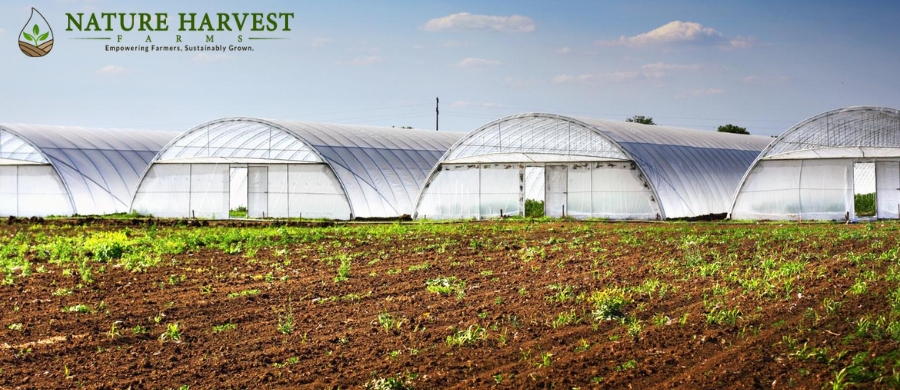
At Nature Harvest Farms, greenhouse selection is based on crop requirements and sustainability goals. By combining fan pad systems, polyhouses, and protected cultivation, NHF ensures:
- Efficient resource utilization
- Consistent crop quality
- Year-round availability
- Reduced environmental impact
This flexible approach allows NHF to grow premium produce while supporting scalable and responsible agriculture.
Future of Greenhouse Farming in India
As India moves toward food security and sustainability, greenhouse farming will play a critical role by:
- Conserving water
- Reducing climate risks
- Supporting farmer incomes
- Meeting B2B quality standards
- Enabling urban and peri-urban farming
Greenhouses are no longer optional, they are essential infrastructure for future-ready agriculture.
Conclusion: Greenhouses as the Foundation of Modern Farming
Fan Pad Greenhouses, Polyhouses, and Net Houses each serve a unique purpose within India’s agricultural ecosystem. Together, they form a strong foundation for Controlled Environment Agriculture.
By choosing the right greenhouse structure, farmers and agribusinesses can grow smarter, reduce risks, and deliver consistent, high-quality produce while protecting natural resources.
Greenhouse farming is not just about growing crops; it’s about building resilient, sustainable food systems for the future.
Explore how Nature Harvest Farms implements Controlled Environment Agriculture to deliver consistent, high-quality produce while supporting sustainable farming practices.


