
Table of Contents
- Introduction: A Turning Point for Indian Agriculture
- What Is Hydroponic Farming?
- Why Traditional Agriculture Is No Longer Enough
- How Hydroponic Farming Solves India’s Biggest Agricultural Challenges
- The Role of Controlled Environment Agriculture (CEA)
- Why Hydroponic Farming Is Ideal for B2B Supply Chains
- Empowering Farmers Through Hydroponic Partnerships
- Sustainability at Scale: Environmental Benefits of Hydroponics
- The Economic Case for Hydroponic Farming in India
- How NHF Is Building the Future of Agriculture
- The Road Ahead: Hydroponics as India’s Agricultural Backbone
- Conclusion: Growing Smarter for a Sustainable Tomorrow
Introduction: A Turning Point for Indian Agriculture
India stands at a critical crossroads in its agricultural journey. With a rapidly growing population, shrinking arable land, water scarcity, climate unpredictability, and rising demand for high-quality food, traditional farming methods are under immense pressure.
In this evolving landscape, hydroponic farming and Controlled Environment Agriculture (CEA) are emerging not as alternatives but as necessities.
Hydroponic farming represents a fundamental shift in how food is grown, managed, and delivered. It replaces dependency on soil and seasons with precision, predictability, and sustainability making it one of the most promising solutions for India’s agricultural future.
At Nature Harvest Farms (NHF), hydroponics is more than a growing method. It is a system designed to empower farmers, conserve resources, and deliver consistent, premium-quality produce to B2B markets year-round.
What Is Hydroponic Farming?
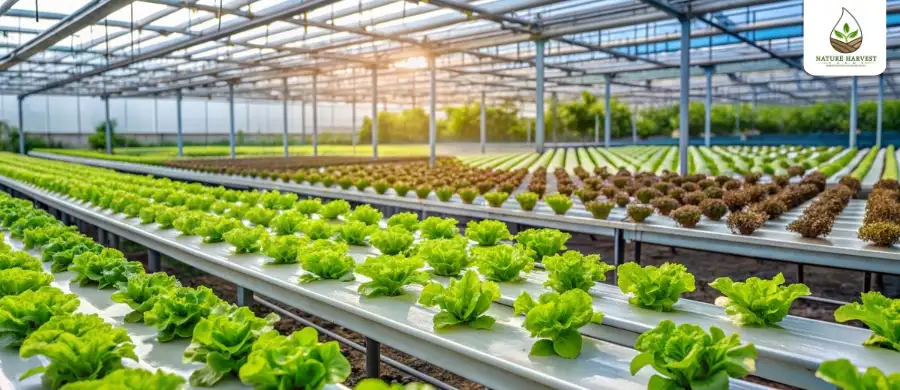
Hydroponic farming is a method of growing plants with or without soil, using a nutrient-rich water solution that delivers essential minerals directly to plant roots.
Instead of relying on natural soil conditions, hydroponics allows farmers to precisely control nutrients, water, oxygen, and climate.
This method is typically implemented within Controlled Environment Agriculture (CEA) systems such as greenhouses or climate-controlled structures where temperature, humidity, and light are regulated.
Key Characteristics of Hydroponic Farming
- No dependency on soil quality
- Significantly reduced water usage
- Faster plant growth cycles
- Consistent crop quality
- Minimal pest and disease exposure
These features make hydroponics especially suitable for countries like India, where traditional farming faces increasing constraints.
Why Traditional Agriculture Is No Longer Enough
While traditional farming has sustained India for centuries, modern challenges demand modern solutions.
1. Water Scarcity
Agriculture consumes nearly 80% of India’s freshwater resources. With groundwater levels declining rapidly, water-intensive farming practices are becoming unsustainable.
2. Climate Uncertainty
Unpredictable monsoons, heatwaves, and extreme weather events make open-field farming highly risky and inconsistent.
3. Shrinking Farmland
Urbanization and industrial development are steadily reducing cultivable land, especially near major consumption centers.
4. Quality & Consistency Issues
Traditional farming struggles to deliver uniform quality, shelf life, and predictable supply for HoReCa and wholesale buyers.
Hydroponic farming addresses all these challenges simultaneously.
How Hydroponic Farming Solves India’s Biggest Agricultural Challenges
1. Water-Efficient by Design
Hydroponic systems use up to 90% less water than traditional soil-based farming. Water is recirculated within closed systems, eliminating wastage.
2. Climate Independence
CEA-based hydroponic farms operate in controlled environments, ensuring stable production regardless of external weather conditions.
3. Higher Yield in Smaller Spaces
Hydroponics allows vertical and dense cultivation, producing significantly higher yields per square meter which is ideal for land-constrained regions.
4. Reduced Chemical Dependency
Controlled environments minimize pest exposure, reducing the need for pesticides and harmful chemicals.
5. Predictable, Year-Round Supply
Hydroponic farms enable planned production cycles, ensuring uninterrupted supply for B2B buyers.
The Role of Controlled Environment Agriculture (CEA)
Controlled Environment Agriculture is the backbone of modern hydroponic farming. It integrates technology, data, and automation to manage every growth parameter.
Core Components of CEA
- Climate control (temperature & humidity)
- Automated irrigation & fertigation
- Nutrient monitoring (pH & EC)
- Artificial or optimized natural lighting
- Real-time data tracking
CEA transforms farming from a seasonal activity into a reliable production system similar to manufacturing, but for fresh food.
Why Hydroponic Farming Is Ideal for B2B Supply Chains
For B2B buyers especially HoReCa, wholesalers, and institutions consistency matters more than abundance.
Hydroponic farming aligns perfectly with B2B requirements:
Uniform Quality
Controlled growth ensures consistent size, texture, and appearance critical for professional kitchens and retail shelves.
Better Shelf Life
Hydroponically grown produce typically lasts longer due to cleaner cultivation and optimized harvesting.
Predictable Volumes
Planned production cycles reduce supply volatility and procurement risks.
Proximity to Markets
Hydroponic farms can be set up closer to urban centers, reducing logistics time and post-harvest losses.
This is where Nature Harvest Farms (NHF) add value, bridging advanced farming with dependable B2B supply chains.
Empowering Farmers Through Hydroponic Partnerships
One of the most overlooked benefits of hydroponic farming is its ability to empower farmers.
Traditional farming places disproportionate risk on farmers’ weather, price fluctuations, crop failure, and middlemen. Hydroponic models shift this dynamic.
How NHF’s Model Supports Farmers
- Access to modern farming technology
- Reduced operational risk
- Stable income opportunities
- Elimination of market uncertainty
- Knowledge and skill development
By integrating farmers into a structured, technology-driven ecosystem, hydroponics creates long-term sustainability not just higher yields.
Sustainability at Scale: Environmental Benefits of Hydroponics
Hydroponic farming aligns seamlessly with India’s sustainability goals.
Environmental Advantages
- Massive reduction in water usage
- Lower land degradation
- Minimal chemical runoff
- Reduced carbon footprint through local sourcing
- Optimized resource utilization
For governments, investors, and ESG-focused partners, hydroponics represents responsible growth.
The Economic Case for Hydroponic Farming in India
Beyond sustainability, hydroponics makes strong economic sense.
Lower Long-Term Costs
While initial setup requires investment, operational efficiency and reduced losses significantly improve margins over time.
Stable Pricing
Controlled output reduces dependence on volatile market conditions.
Premium Market Access
Hydroponic produce often commands higher value due to quality, safety, and consistency.
Scalability
CEA systems can be replicated and expanded without proportional increases in risk.
This scalability is critical for meeting India’s growing food demand.
How NHF Is Building the Future of Agriculture
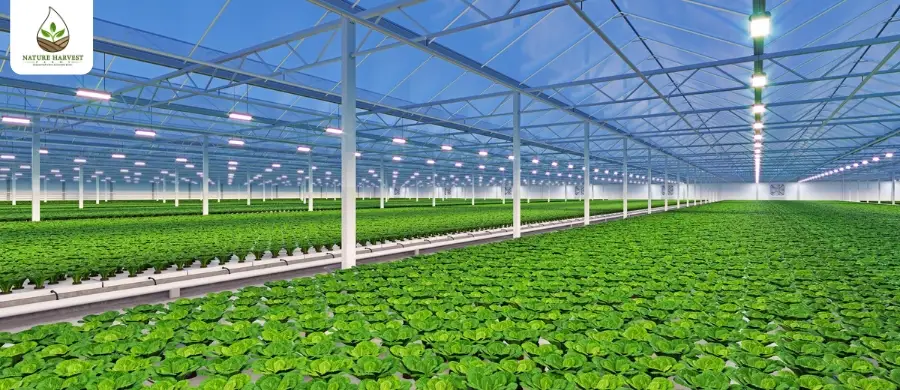
Nature Harvest Farms (NHF) represents the next generation of Indian agriculture where technology, sustainability, and farmer empowerment converge.
NHF’s approach focuses on:
- Precision-driven hydroponic farming
- Scalable CEA infrastructure
- Reliable B2B supply chains
- Sustainable resource management
Rather than chasing short-term yields, NHF builds systems designed for long-term resilience and growth.
The Road Ahead: Hydroponics as India’s Agricultural Backbone
As India moves toward smarter cities, sustainable industries, and food security, hydroponic farming will play a central role.
It offers a solution that:
- Conserves water
- Reduces environmental impact
- Supports farmers
- Meets professional food industry standards
- Delivers consistent, high-quality produce
Hydroponics is not a trend, it is the foundation of future-ready agriculture.
Conclusion: Growing Smarter for a Sustainable Tomorrow
The future of agriculture in India depends on how efficiently we use resources, empower farmers, and deliver food to growing populations.
Hydroponic farming supported by Controlled Environment Agriculture offers a proven, scalable, and sustainable path forward.
At Nature Harvest Farms, this future is already taking shape. By combining science-driven farming, NHF is helping redefine how India grows its food smarter, cleaner, and more sustainably.
Have a specific requirement or volume need? Our team is here to help.


