Table of Contents
- Are Green, Yellow, and Red Bell Peppers the Same Pepper?
- Capsicum Color Change: What Happens to the Pigments?
- Does a Bell Pepper Always Go Green → Yellow → Red?
- Bell Pepper Color Stages Explained
- What Is the Color Transition Stage in Bell Peppers?
- Why Are Some Peppers Green While Others on the Same Plant Are Changing Colour?
- Red Yellow Green Capsicum: What Is the Main Difference?
- Why Do Red Bell Peppers Often Taste Sweeter Than Green Peppers?
- Why Controlled Environment Agriculture Helps Capsicum Production
- When Is a Bell Pepper Ready to Harvest?
- Bell Pepper Ripening vs. Bell Pepper Growth: What’s the Difference?
- Why Color Consistency Matters in Bulk Capsicum
- Nature Harvest Farms and Colored Capsicum in Gujarat
- Bell Pepper Color Change: Simple Stage-by-Stage Explanation
- Why Do Bell Peppers Change From Green to Yellow or Red?
- FAQs
- Final Thoughts
If you have ever watched bell peppers growing on a plant, you may notice an interesting transformation.
The fruit commonly begins green and, depending on the variety, gradually develops yellow or red colour as it matures.
This natural capsicum color change is one of the clearest visible signs that the fruit is progressing through its ripening process.
But why does it happen?
The simple explanation is that the pigments inside the pepper change as the fruit matures. Green peppers contain high levels of chlorophyll. During bell pepper ripening, much of that chlorophyll gradually breaks down while other natural pigments develop and become more visible.
Understanding bell pepper colors is useful not only for growers but also for consumers, restaurants, hotels, wholesalers, retailers, chefs, and commercial vegetable buyers who purchase red yellow green capsicum at different maturity stages.
Nature Harvest Farms, based in Anand district, Gujarat, grows capsicum as part of its Controlled Environment Agriculture operations and works with commercial fresh-produce buyers looking for fresh coloured vegetables.
Why Do Bell Peppers Change Color?
Bell peppers change colour as they mature because the natural pigments inside the fruit change.
Immature bell peppers are commonly green because chlorophyll is the dominant pigment.
As ripening progresses:
- Chlorophyll begins to break down.
- The green colour gradually becomes less dominant.
- Other natural pigments develop and become visible.
- The pepper develops its mature colour according to its variety.
Depending on the variety, the mature fruit may become:
- Red
- Yellow
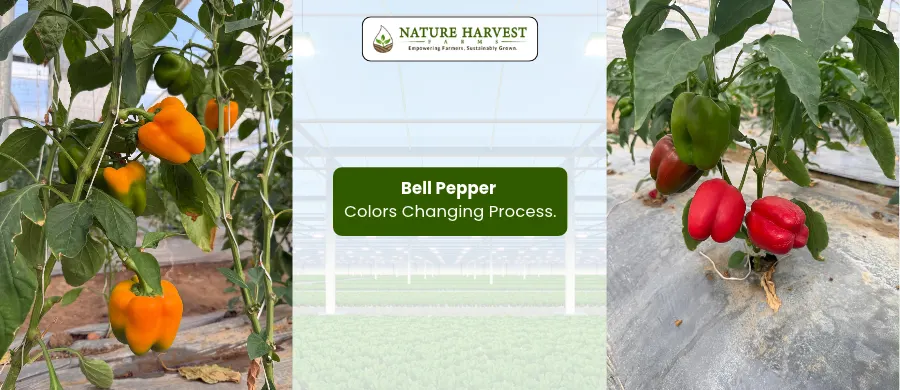
So while the phrase green to yellow to red is often used when discussing bell pepper colour development, not every individual pepper follows exactly that sequence.
Some varieties mature from green to red.
Others mature from green to yellow.
Are Green, Yellow, and Red Bell Peppers the Same Pepper?
Sometimes different colours can represent different maturity stages, but it is not accurate to assume that every green pepper first turns yellow and then becomes red.
Many bell peppers begin green while immature.
After that, their mature colour depends on the variety.
A red variety may mature:
Green → Red
A yellow variety may mature:
Green → Yellow
During the transition, peppers can temporarily show mixed shades as their pigment composition changes.
This is why a capsicum farm may contain peppers at different colours and maturity stages at the same time.
What Makes an Unripe Bell Pepper Green?
The green colour comes primarily from chlorophyll.
Chlorophyll is the pigment associated with photosynthesis and gives immature pepper fruits their familiar green appearance.
During the early stages of fruit development, chlorophyll is highly visible within the fruit.
That is why a young bell pepper is generally green even if it will eventually mature into a red or yellow pepper.
What Happens During Bell Pepper Ripening?
Bell pepper ripening involves much more than an external colour change.
As the fruit matures, several biological processes take place.
These can include:
- Chlorophyll degradation
- Development of mature pigments
- Changes in flavour
- Changes in sugars
- Changes in texture
- Changes in aroma
- Changes in nutritional composition
The visible colour transition is simply one of the easiest parts of this process for growers and consumers to observe.
Capsicum Color Change: What Happens to the Pigments?
The colour transition can be understood through two major processes.
1. Chlorophyll Declines
During the immature stage, chlorophyll gives the fruit its green colour.
As ripening progresses, chlorophyll gradually breaks down.
The green colour therefore becomes less dominant.
2. Mature Colour Pigments Develop
As the fruit continues ripening, other naturally occurring pigments become increasingly visible.
These pigments help create the:
- Yellow
- Red
colours associated with mature bell peppers.
The exact final colour depends mainly on the variety being grown.
Why Do Some Bell Peppers Turn Red?
Red bell peppers develop their mature colour because of natural pigment changes during ripening.
A red-fruited variety normally begins green.
As the fruit matures:
- Green chlorophyll declines
- Red pigments become increasingly visible
- The fruit gradually develops stronger red colour
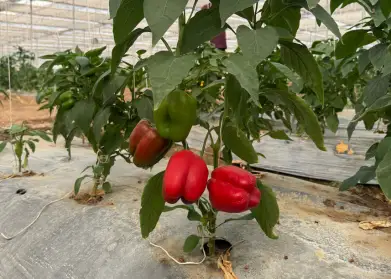
The pepper may first show a small coloured patch before more of the fruit becomes red.
Eventually, the fruit can reach the mature red colour associated with that variety.
Why Do Some Bell Peppers Turn Yellow?
Yellow bell peppers also commonly begin green.
As the fruit matures, the green chlorophyll declines while pigments responsible for yellow colouring become more visible.
A yellow-fruited variety may therefore progress roughly as:
Green → Transitional Colour → Yellow
Once adequately mature, it develops the bright yellow colour valued by restaurants, hotels, caterers, retailers, and other fresh-produce buyers.
Does Every Green Bell Pepper Turn Red?
No.
This is one of the most important facts to understand about colored capsicum.
Depending on the variety, a green immature pepper may mature into:
- Red capsicum
- Yellow capsicum
Therefore:
Green is often an immature stage.
But:
Red is not the mature colour of every bell pepper variety.
The variety largely determines whether the mature fruit will be red or yellow.
Does a Bell Pepper Always Go Green → Yellow → Red?
No.
The phrase green to yellow to red is useful for discussing visible colour changes in bell peppers, but it should not be treated as a universal sequence for every fruit.
A red variety may move from green through transitional shades before becoming fully red.
A yellow variety may move from green toward yellow and remain yellow when mature.
The exact progression depends on:
- Variety
- Genetics
- Pigment development
- Ripening stage
- Growing conditions
This distinction is important because consumers sometimes assume that yellow capsicum is always simply an intermediate stage before red capsicum.
That is not necessarily true.
Bell Pepper Color Stages Explained
A simplified ripening process can be understood as follows:
| Stage | Typical Appearance | What Is Happening |
|---|---|---|
| Early Fruit Development | Green | Fruit is forming and chlorophyll is prominent |
| Growing Stage | Green | Fruit increases in size and develops shape |
| Mature Green | Full-sized green fruit | Fruit may already be suitable for green capsicum harvest |
| Colour Transition | Green with developing mature colour | Chlorophyll declines and mature colour begins appearing |
| Advanced Ripening | Increasing yellow or red colour | Mature pigments become more dominant |
| Fully Coloured | Red or yellow | Fruit reaches the mature colour of its variety |
Actual colour development varies depending on the variety and crop conditions.
What Is the Color Transition Stage in Bell Peppers?
The transition stage begins when the first visible mature colour starts appearing on a predominantly green fruit.
For example, a red variety may appear as:
Green → small coloured patch → increasing red → fully red
A yellow variety may appear as:
Green → partial yellow colouring → increasing yellow → fully yellow
This stage shows that the fruit is moving through the ripening process.
For growers, it is an important visual indication that mature colour development has begun.
Why Are Some Peppers Green While Others on the Same Plant Are Changing Colour?
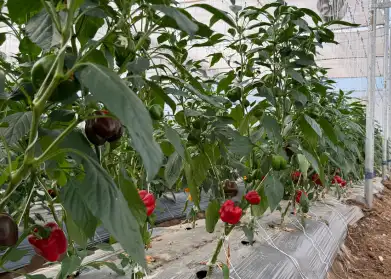
Bell peppers on the same plant do not necessarily develop at exactly the same time.
One fruit may have formed earlier than another.
Therefore, a single plant can sometimes contain:
- Small developing fruits
- Larger green fruits
- Fruits beginning to change colour
- More mature red or yellow fruits
This does not necessarily indicate a problem.
It often simply means that individual fruits are at different developmental and ripening stages.
This is especially common during the middle and later stages of capsicum production.
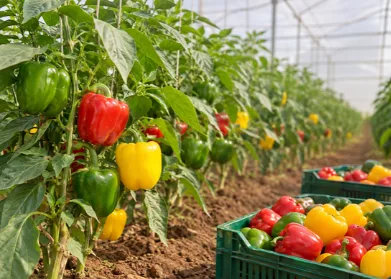
Red Yellow Green Capsicum: What Is the Main Difference?
The most obvious difference is colour, but maturity can also influence flavour and other characteristics.
| Capsicum | Typical Stage | Common Characteristics |
|---|---|---|
| Green | Commonly harvested before full mature colour | Crisp texture and fresh vegetal flavour |
| Yellow | Mature colour of yellow varieties | Bright appearance and generally sweeter flavour |
| Red | Mature colour of red varieties | Strong mature colour and generally sweeter flavour |
Green capsicum is commonly harvested before complete colour development.
Yellow and red capsicum generally remain on the plant longer to develop their mature colour.
Why Do Red Bell Peppers Often Taste Sweeter Than Green Peppers?
Ripening changes more than colour.
As peppers mature, changes can occur in:
- Natural sugars
- Organic acids
- Aroma compounds
- Pigments
- Other metabolites
This helps explain why mature red peppers often taste sweeter than peppers harvested at the green stage.
Yellow peppers can also develop a milder, sweeter flavour as they mature.
For consumers and chefs, bell pepper colour can therefore influence both appearance and flavour.
Does Color Change Affect Nutritional Composition?
Yes.
The nutritional and phytochemical composition of capsicum can change as the fruit matures.
Ripening may influence compounds including:
- Carotenoids
- Vitamin-related compounds
- Antioxidants
- Phenolic compounds
- Other natural plant compounds
This does not mean that one colour should automatically be considered good and another bad.
Green, yellow, and red peppers can all be valuable fresh vegetables with different maturity and pigment profiles.
Why Doesn’t the Entire Bell Pepper Change Colour at Once?
Colour development often begins in one area of the fruit and gradually spreads.
A pepper may temporarily appear:
- Mostly green with a yellow patch
- Partially green and yellow
- Mostly green with a red patch
- Partially green and red
- Mostly red with a small green area
These intermediate appearances can be completely normal during capsicum color change.
The fruit is simply progressing through its ripening stage.
What Factors Affect Bell Pepper Color Development?
Several factors can influence fruit development and colour quality.
These include:
- Variety
- Genetics
- Temperature
- Light
- Plant health
- Nutrition
- Water management
- Fruit maturity
- Crop load
- Growing environment
The final mature colour is mainly determined by the variety, while growing conditions can influence how effectively the crop develops and ripens.
Why Temperature Matters for Bell Pepper Ripening
Capsicum is sensitive to its growing environment.
Temperature influences many plant processes related to:
- Plant growth
- Flower development
- Fruit setting
- Fruit development
- Ripening
- Colour development
Poorly managed growing conditions can affect overall crop performance and fruit quality.
This is one reason controlled cultivation can be useful for commercial capsicum production.
Why Controlled Environment Agriculture Helps Capsicum Production
Controlled Environment Agriculture, or CEA, allows growers to manage important crop conditions more closely than completely exposed farming systems.
Depending on the growing system, growers may monitor:
- Temperature
- Humidity
- Irrigation
- Nutrition
- Crop health
- Plant development
- Pest and disease pressure
For a crop such as capsicum, these factors matter throughout the growth cycle.
Nature Harvest Farms follows a Controlled Environment Agriculture model in Gujarat and grows commercial vegetables including capsicum.
Fully coloured red and yellow peppers generally need to remain on the plant longer than peppers harvested green.
Maintaining healthy crop conditions during this additional growing period is important for:
- Fruit size
- Firmness
- Colour development
- Appearance
- Commercial quality
Does Red Capsicum Take Longer to Grow Than Green Capsicum?
When both come from a variety that eventually matures red, the fully red pepper generally needs to remain on the plant longer.
Green peppers can be harvested before complete mature colour development.
For a red pepper to develop mature red colour, it must remain on the plant and continue through the ripening process.
The same principle applies to yellow varieties.
A yellow capsicum generally requires additional time to develop its characteristic mature yellow colour compared with the same fruit being harvested earlier at the green stage.
Can Green Capsicum Be Harvested Before It Changes Colour?
Yes.
Green capsicum is commonly harvested before the fruit develops its mature red or yellow colour.
At the mature-green stage, a pepper may already have:
- Suitable commercial size
- Firm texture
- Developed shape
- Good green appearance
This makes green bell peppers commercially valuable even though they have not completed the full colour-ripening process.
Why Would a Grower Harvest Capsicum Green?
There can be several commercial reasons.
Market demand may specifically require green capsicum.
Restaurants commonly use green peppers for:
- Pizza
- Indian dishes
- Indo-Chinese food
- Stir-fries
- Curries
- Sandwiches
- Mixed vegetables
Wholesalers and retailers may also require separate quantities of green, yellow, and red peppers.
Therefore, the right harvest stage depends partly on the buyer’s requirement.
Why Leave Bell Peppers on the Plant to Develop Colour?
When the market requires red or yellow peppers, the fruit needs sufficient time to develop the required mature colour.
Leaving the fruit on the plant allows ripening to continue.
During this period:
- Chlorophyll continues declining
- Mature pigments become visible
- Colour develops further
- Flavour can change
- Fruit chemistry continues changing
This longer maturation period is one reason fully coloured peppers require careful crop management.
When Is a Bell Pepper Ready to Harvest?
There is no single harvest stage that is right for every buyer.
Harvest timing depends on the required product.
For Green Capsicum
Growers may harvest when the fruit reaches suitable:
- Size
- Shape
- Firmness
- Green colour
- Commercial maturity
For Red Capsicum
The fruit generally remains on the plant until the required red colour develops.
For Yellow Capsicum
The fruit generally remains on the plant until the characteristic yellow colour develops.
Commercial harvest therefore depends on both fruit maturity and buyer specifications.
Bell Pepper Ripening vs. Bell Pepper Growth: What’s the Difference?
Growth and ripening are related, but they are not exactly the same process.
Growth
During growth, the fruit develops:
- Size
- Shape
- Tissue
- Weight
Ripening
During ripening, important changes occur in:
- Colour
- Pigments
- Flavour
- Texture
- Chemical composition
A bell pepper can therefore become relatively large while still remaining green and then undergo further colour development afterward.
Why Bell Pepper Colors Matter to Restaurants and Retailers
Colour has strong commercial importance.
Restaurants use red yellow green capsicum to add visual contrast to:
- Salads
- Pasta
- Pizzas
- Stir-fries
- Sandwiches
- Grilled dishes
- Continental dishes
- Buffet presentations
Retailers also value attractive and appropriately mature colour because shoppers often assess fresh produce visually.
For commercial buyers, colour therefore affects both:
Product specification
and
Presentation value
Colored Capsicum for Commercial Buyers
Commercial buyers usually need more than simply “capsicum.”
They may require specific combinations such as:
- Green capsicum
- Red capsicum
- Yellow capsicum
- Mixed red, yellow, and green capsicum
- Specific size grades
- Recurring quantities
This is why hotels, restaurants, wholesalers, institutional kitchens, caterers, supermarkets, retailers, and food processors should communicate colour requirements clearly when ordering.
Why Color Consistency Matters in Bulk Capsicum
Consider a restaurant that orders red and yellow peppers specifically for premium salads.
If the restaurant receives:
- Mostly green fruit
- Poorly developed colour
- Highly inconsistent maturity
the visual presentation of its dishes may be affected.
Likewise, a retailer may prefer fruits with strong characteristic colour because appearance plays an important role in customer selection.
For bulk buyers, consistent bell pepper colors can therefore be an important commercial quality specification.
Nature Harvest Farms and Colored Capsicum in Gujarat
Nature Harvest Farms is a Gujarat-based agribusiness focused on Controlled Environment Agriculture and fresh-produce supply.
The farm is based in Anand district, Gujarat, and capsicum forms part of its commercial crop portfolio.
Nature Harvest Farms works with B2B markets that may include:
- Hotels
- Restaurants
- HoReCa businesses
- Wholesalers
- Institutional kitchens
- Retailers
- Distributors
- Food processors
- Other commercial fresh-produce buyers
For commercial colored capsicum requirements, buyers can discuss:
- Required colour
- Quantity
- Harvest availability
- Grade
- Size
- Packaging
- Delivery requirements
- Recurring supply needs
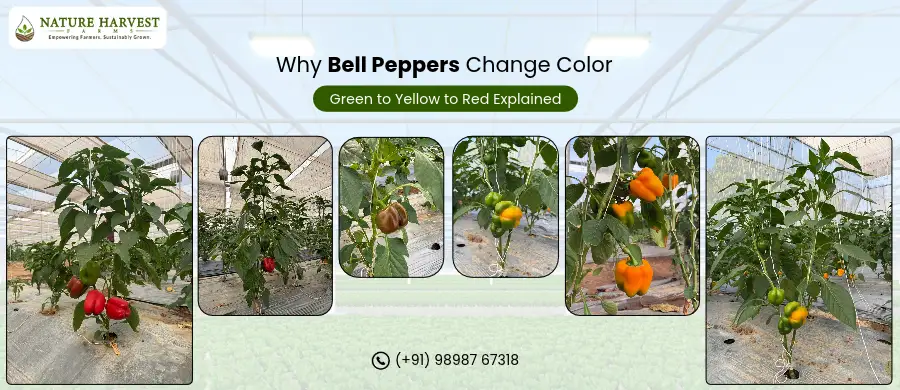
Bell Pepper Color Change: Simple Stage-by-Stage Explanation
Here is the process in simple terms:
Stage 1: Fruit Formation
A young pepper begins developing after successful flowering and fruit set.
Stage 2: Green Growth
The fruit grows larger while chlorophyll gives it a green appearance.
Stage 3: Mature Green
The fruit reaches a commercially usable size while still green.
Stage 4: Color Change Begins
The first mature red or yellow colouring begins appearing.
Stage 5: Color Development
Chlorophyll declines while mature colour becomes increasingly visible.
Stage 6: Fully Colored Fruit
The pepper reaches the mature colour associated with its variety.
This may be:
- Red
- Yellow
Why Do Bell Peppers Change From Green to Yellow or Red?
Bell peppers change colour during ripening because their natural pigment composition changes. Immature peppers are commonly green because chlorophyll is dominant. As the fruit matures, chlorophyll declines and other pigments become more visible, producing mature yellow or red colours depending on the variety. Not every green bell pepper passes through yellow before becoming red.
FAQs
Why do bell peppers change colour?
Do all bell peppers start green?
Does every green bell pepper become red?
Do bell peppers go from green to yellow to red?
What makes red bell peppers red?
What makes green bell peppers green?
Why are yellow bell peppers yellow?
Are red peppers more mature than green peppers?
Are yellow bell peppers just unripe red peppers?
Why are red peppers often sweeter than green peppers?
Can bell peppers be harvested green?
Why are several colours visible on one pepper?
Does colour indicate bell pepper ripeness?
How long should bell peppers stay on the plant to change colour?
Does Nature Harvest Farms grow coloured capsicum?
Final Thoughts
The changing bell pepper colors visible on the plant are part of the natural ripening process.
Young peppers are commonly green because chlorophyll dominates their appearance.
As bell pepper ripening continues, chlorophyll declines and mature pigments become increasingly visible.
That natural capsicum color change can produce:
- Red capsicum
- Yellow capsicum
depending on the variety.
So when looking at red yellow green capsicum, remember that colour reflects a combination of:
- Variety
- Genetics
- Pigment development
- Ripening stage
- Growing conditions
Not every green pepper has to turn yellow and then red.
Some varieties mature red.
Some varieties mature yellow.
And green peppers can also be intentionally harvested before their mature colour develops.
For growers and commercial buyers, understanding the colour-development process makes it easier to plan harvest maturity, product specifications, and market requirements.
Nature Harvest Farms, based in Anand district, Gujarat, uses Controlled Environment Agriculture to support quality-focused capsicum production and commercial fresh-produce supply.
For buyers looking for fresh colored capsicum, the most important step is to specify whether they require green, yellow, red, or a combination of these colours along with quantity, grade, and delivery requirements.
Looking for Fresh Colored Capsicum?
Connect with Nature Harvest Farms for fresh red, yellow, and green capsicum for HoReCa, wholesale, retail, institutional, and other commercial requirements.
From Green Growth to Vibrant Colour. Naturally Grown.