
Table of Contents
- How Do You Choose Fresh Capsicum for a Restaurant or Hotel?
- Why Capsicum Quality Matters in Professional Kitchens
- Check the Firmness of the Capsicum
- Look for Fresh, Healthy Skin
- Choose the Right Capsicum Colour for Your Menu
- Check Colour Development and Appearance
- Evaluate Shape Based on the Application
- Think About Usable Yield, Not Only Purchase Price
- Fresh Capsicum Quality Checklist for Restaurants and Hotels
- Match Capsicum Quality to Your Restaurant Menu
- Plan Your Required Quantity
- Review Packaging and Handling
- Inspect Every Delivery
- Consistency Matters More Than One Perfect Delivery
- How to Choose a Colored Capsicum Supplier
- Why Controlled Growing Environments Can Matter
- Fresh Capsicum vs. Premium Capsicum: Is There a Difference?
- What Should Restaurants Ask Before Ordering Capsicum?
- Restaurant Capsicum Buying Example
- Why Local Sourcing Can Be Useful for Gujarat HoReCa Buyers
- How Should Hotels Store Fresh Capsicum After Delivery?
- Common Mistakes When Buying Capsicum for Restaurants and Hotels
- FAQs
- Final Thoughts
For restaurants, hotels, cafés, caterers, cloud kitchens, and institutional kitchens, capsicum is more than just another vegetable on the purchasing list. Its freshness, firmness, colour, size, and consistency can directly affect food preparation, presentation, usable yield, and kitchen efficiency.
Whether capsicum is being used for pizzas, salads, pasta, sandwiches, stir-fries, grilled vegetables, curries, banquet dishes, or buffet presentations, professional kitchens need produce that performs consistently from one order to the next.
That is why choosing fresh capsicum should not be based only on price.
Restaurants and hotels purchasing vegetables regularly should evaluate freshness, firmness, colour development, size consistency, surface condition, grading, packaging, expected consumption, and supply reliability before selecting a supplier.
This guide explains how chefs, purchase managers, hotel procurement teams, restaurant owners, and HoReCa businesses can identify premium capsicum, reduce avoidable wastage, and choose the right colored capsicum supplier for recurring commercial requirements.
How Do You Choose Fresh Capsicum for a Restaurant or Hotel?
For restaurant or hotel use, choose capsicum that is:
- Firm and crisp
- Fresh in appearance
- Bright and naturally coloured
- Free from excessive shrivelling
- Free from major bruises, cuts, decay, and soft spots
- Reasonably uniform in size for the intended application
- Suitable for your required green, red, or yellow colour specification
- Properly graded and handled
- Available in quantities that match kitchen consumption
Commercial buyers should also consider the supplier’s ability to maintain consistent quality across recurring orders.
Fresh capsicum should generally appear healthy, crisp and reasonably firm, with appropriate colour and minimal visible damage. Uniformity can also matter for commercial buyers purchasing produce for standardized food preparation.
Why Capsicum Quality Matters in Professional Kitchens
In a household, purchasing a few peppers with slightly different shapes or sizes may not create a major issue.
In a restaurant or hotel kitchen, however, ingredient inconsistency can become more noticeable.
A commercial kitchen may prepare dozens or hundreds of portions each day. If one delivery contains firm, well-sized capsicum and the next contains soft or inconsistent produce, preparation and portioning may become less predictable.
Good-quality capsicum for restaurants can support:
- Consistent slicing and chopping
- Better plate presentation
- More predictable usable yield
- Easier portion control
- Faster kitchen preparation
- Reduced avoidable trimming
- Better inventory planning
Hotels have similar concerns, particularly when capsicum is used across restaurant kitchens, buffet service, room service, banquets, catering, and event menus.
For that reason, selecting capsicum for hotels should involve both product quality and supply planning.
Check the Firmness of the Capsicum
Firmness is one of the easiest quality indicators to evaluate when purchasing capsicum.
Fresh capsicum should generally feel firm rather than soft, limp, or heavily shrivelled. Industry quality guidance also emphasizes reasonably firm, fresh and crisp peppers.
When inspecting capsicum, avoid produce with:
- Very soft areas
- Excessive wrinkling
- Limp texture
- Collapsed sections
- Visible deterioration
A firm pepper is generally easier for kitchen staff to wash, cut, slice, dice, grill, or stuff.
Why firmness matters for restaurants
Suppose a restaurant serves pizzas, salads, sandwiches, and stir-fries.
Capsicum may need to be:
- Thinly sliced
- Diced into uniform pieces
- Cut into strips
- Grilled
- Used raw
Consistent firmness makes these preparation tasks easier.
Look for Fresh, Healthy Skin
The surface of the capsicum can tell buyers a lot about its condition.
Good-quality peppers should have a clean, fresh appearance with relatively smooth skin and minimal physical damage.
Inspect each batch for:
- Cuts
- Bruising
- Excessive shrivelling
- Soft spots
- Decay
- Discolouration
- Pest-related damage
- Broken skin
Commercial quality guidance for capsicum also emphasizes freshness, healthy appearance and freedom from obvious decay and significant physical defects.
Minor natural differences may occur because capsicum is agricultural produce, but excessive damage can reduce the usable quantity available to the kitchen.
Choose the Right Capsicum Colour for Your Menu
Restaurants and hotels commonly purchase:
Green Capsicum
Green capsicum is widely used in:
- Indian dishes
- Indo-Chinese food
- Pizzas
- Sandwiches
- Curries
- Stir-fries
- Mixed vegetables
Red Capsicum
Red capsicum is often chosen for:
- Salads
- Pasta
- Premium pizzas
- Grilled dishes
- Sandwiches
- Continental recipes
- Plated presentations
Yellow Capsicum
Yellow capsicum works well in:
- Mixed salads
- Pasta
- Stir-fries
- Sandwiches
- Buffet dishes
- Premium food presentations
Mixed Coloured Capsicum
Many restaurants and hotels use a combination of red, yellow, and green capsicum to create more colourful presentations.
Before placing a bulk order, specify exactly which colours are needed.
Do not simply request “coloured capsicum” if your menu specifically requires particular quantities of red or yellow peppers.
Check Colour Development and Appearance
Colour plays an important commercial role in capsicum selection.
For many restaurant dishes, the appearance of the vegetable remains visible after preparation.
That means dull, uneven, damaged, or poorly developed colour may affect presentation.
Quality capsicum should generally show the characteristic colour expected for its variety and maturity. Commercial quality references also use colour, brightness, firmness and overall appearance as grading factors.
For restaurants and hotels, colour consistency becomes particularly useful when preparing:
- Buffet salads
- Garnishes
- Premium pizzas
- Continental dishes
- Mixed vegetable platters
- Catering presentations
Consider Size Consistency
The largest capsicum is not always the best capsicum.
The correct size depends on how the kitchen plans to use it.
A restaurant purchasing capsicum for slicing may value relatively uniform peppers because they can help kitchen staff produce consistent portions.
A hotel preparing buffet food may need a different size specification.
A food processor may care more about usable weight and processing yield.
A premium retail buyer may prioritize visual size and appearance.
Therefore, before selecting premium capsicum, determine what size range works best for your operation.
Ask yourself:
- Will the capsicum be sliced?
- Diced?
- Stuffed?
- Grilled?
- Used for salads?
- Used primarily for cooking?
- Displayed whole?
Once the application is clear, discuss preferred sizing with the supplier.
Evaluate Shape Based on the Application
Capsicum naturally varies in shape.
For many commercial kitchens, exact uniformity is unnecessary.
However, relatively consistent shape can be helpful for standardized preparation.
For example, restaurants that regularly prepare:
- Capsicum rings
- Stuffed peppers
- Uniform strips
- Decorative slices
may prefer peppers with predictable shape and dimensions.
Commercial grading standards often consider peppers that are reasonably well-shaped and reasonably uniform within a lot.
The key is to match the product specification to how the kitchen actually uses it.
Think About Usable Yield, Not Only Purchase Price
One of the most important purchasing principles for commercial kitchens is:
The cheapest capsicum per kilogram is not necessarily the lowest-cost capsicum to use.
Consider two batches.
Batch A
Lower purchase price, but includes:
- More bruising
- Softer peppers
- Greater trimming
- Inconsistent sizes
Batch B
Slightly higher price, but offers:
- Better firmness
- More consistent quality
- Less trimming
- Higher usable quantity
The real comparison should be based on usable produce, not just invoice price.
For hotels and restaurants purchasing capsicum regularly, even small differences in waste can become meaningful over time.
Ask About Grading
Commercial buyers should understand how their supplier grades capsicum.
Grading may consider factors such as:
- Size
- Colour
- Firmness
- Shape
- Physical condition
- Visual appearance
Different businesses may need different grades.
A high-end restaurant preparing visible fresh salads may prioritize appearance more heavily than a kitchen using capsicum mainly in cooked sauces or mixed preparations.
When contacting a colored capsicum supplier, explain the intended use instead of simply asking for “best quality.”
This allows both buyer and supplier to discuss a more practical specification.
Fresh Capsicum Quality Checklist for Restaurants and Hotels
| Quality Factor | What to Look For |
|---|---|
| Firmness | Firm, crisp texture |
| Skin | Clean and reasonably smooth |
| Colour | Appropriate red, yellow, or green colour |
| Freshness | Fresh, healthy appearance |
| Damage | Minimal cuts, bruising and soft areas |
| Shrivelling | Minimal |
| Size | Suitable and reasonably consistent for your application |
| Shape | Appropriate for intended preparation |
| Grading | Clear commercial specification |
| Supply | Quantity suitable for recurring requirements |
Using a simple incoming-quality checklist can help purchasing and kitchen teams maintain consistent standards.
Match Capsicum Quality to Your Restaurant Menu
Different menus create different buying requirements.
Pizza Restaurants
Pizza businesses may prioritize:
- Firm peppers
- Easy slicing
- Good colour
- Consistent sizes
- Regular supply
Fine-Dining Restaurants
Premium restaurants may place greater emphasis on:
- Appearance
- Colour
- Freshness
- Shape
- Presentation quality
Hotels
Hotels may need capsicum across several departments, including:
- Restaurant kitchens
- Banquets
- Buffet preparation
- Room service
- Catering
This means volume and demand can change depending on occupancy, events, and bookings.
Cloud Kitchens
Cloud kitchens may prioritize:
- Consistent specifications
- Predictable quantities
- Easy preparation
- Efficient procurement
Caterers
Catering operations may require larger quantities for specific events, creating sudden changes in demand.
The best capsicum for restaurants or hotels is therefore not defined by one universal specification. It depends on the menu, preparation method, volume, and presentation expectations.
Plan Your Required Quantity
A reliable procurement system begins with understanding consumption.
Track:
- Daily capsicum usage
- Weekly consumption
- Colour-wise requirement
- Peak-demand days
- Events and bookings
- Seasonal menu changes
- Current wastage
For example, instead of telling a supplier:
“We need coloured capsicum regularly.”
A more useful requirement would be:
“We require approximately X kg per week, divided between red, yellow, and green capsicum.”
Clear purchasing information helps improve supply planning.
Review Packaging and Handling
Freshness does not depend only on cultivation.
Post-harvest handling, packaging, transportation, and storage can also affect the condition in which capsicum reaches a restaurant or hotel.
Commercial buyers should discuss:
- Packaging format
- Quantity per pack or crate
- Handling
- Delivery schedule
- Transport arrangements
- Receiving procedure
Capsicum should be handled carefully enough to minimize unnecessary bruising and physical damage.
Inspect Every Delivery
Even when working with a regular supplier, commercial buyers should have a simple receiving process.
When an order arrives, inspect:
- Colour
- Firmness
- Surface condition
- Size consistency
- Quantity
- Visible damage
- Overall freshness
Record repeated issues.
This gives the purchasing team objective information when discussing quality with the supplier.
Consistency Matters More Than One Perfect Delivery
One excellent shipment does not automatically make a supplier suitable for a hotel or restaurant.
Professional kitchens need repeatability.
For recurring orders, evaluate performance across multiple deliveries.
Ask:
- Is freshness consistently acceptable?
- Are the requested colours supplied correctly?
- Does size remain reasonably consistent?
- Are commercial quantities available?
- Does quality change significantly between deliveries?
- Can upcoming requirements be discussed in advance?
For HoReCa businesses, dependable recurring performance is often more important than receiving one visually perfect batch.
How to Choose a Colored Capsicum Supplier
When comparing suppliers, do not evaluate only the price per kilogram.
Consider the complete purchasing relationship.
A suitable supplier should be able to clearly discuss:
- Available capsicum colours
- Current availability
- Expected quantities
- Product grading
- Quality expectations
- Packaging
- Delivery location
- Order frequency
- Commercial requirements
Businesses searching for a colored capsicum supplier should also consider whether the supplier understands recurring B2B purchasing rather than only occasional retail orders.
Why Controlled Growing Environments Can Matter
Capsicum quality is influenced by many factors, including crop variety, growing conditions, crop management, harvest timing, handling, and storage.
Controlled Environment Agriculture allows growers to manage important growing conditions more closely than completely exposed cultivation systems.
This does not mean every pepper will look identical—fresh produce naturally varies—but controlled cultivation can support more organized commercial production and quality-focused crop management.
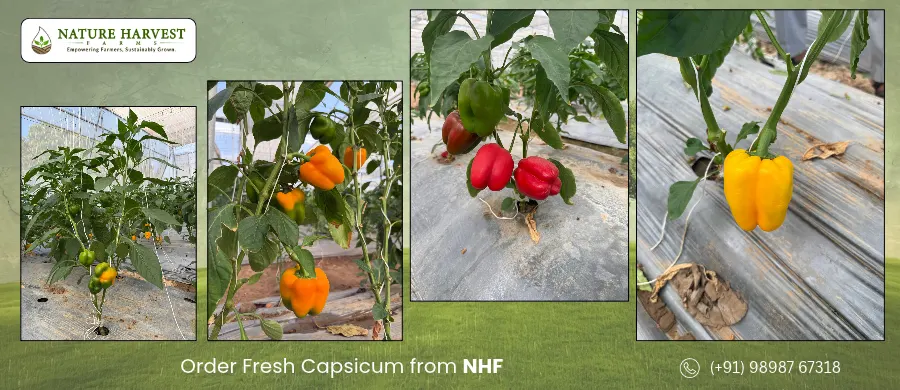
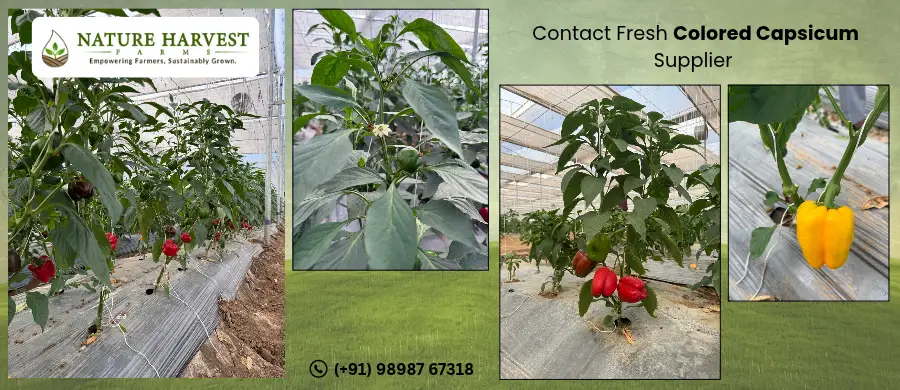
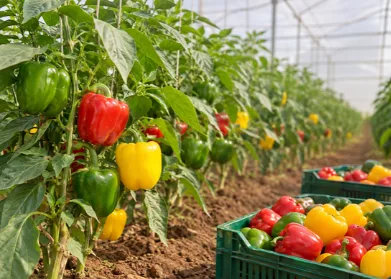
Nature Harvest Farms follows a Controlled Environment Agriculture approach and focuses on supplying fresh coloured capsicum and other premium vegetables to commercial buyers in Gujarat. Its B2B market includes restaurants, hotels, HoReCa businesses, wholesalers, institutional kitchens, distributors, and other commercial fresh-produce buyers.
Fresh Capsicum vs. Premium Capsicum: Is There a Difference?
The terms are often used together, but they describe slightly different considerations.
Fresh Capsicum
Freshness primarily refers to the condition of the produce, including factors such as:
- Firmness
- Crispness
- Fresh appearance
- Minimal deterioration
- Minimal shrivelling
Premium Capsicum
Premium capsicum generally suggests that additional commercial characteristics are also important, such as:
- Strong visual appearance
- Appropriate colour
- Better consistency
- Suitable size
- Proper grading
- Minimal visible damage
For professional kitchens, both matter.
Freshness supports usability, while grading and consistency help support kitchen operations and food presentation.
What Should Restaurants Ask Before Ordering Capsicum?
Before placing an order, ask the supplier:
1. Which colours are currently available?
Confirm whether you need green, red, yellow, or a specific mix.
2. What size or grade is available?
Describe your preferred specification.
3. What quantities can be supplied?
Match availability to your weekly requirement.
4. How is the capsicum packed?
Packaging affects receiving, handling, and storage.
5. Can recurring orders be planned?
This is important for hotels, restaurants, institutional kitchens, and other regular buyers.
6. Where is the produce coming from?
Understanding the source can help buyers evaluate their procurement chain.
7. What delivery arrangements are available?
Never assume every delivery location or schedule is automatically covered.
Restaurant Capsicum Buying Example
Imagine a restaurant uses capsicum for:
- Pizza
- Pasta
- Salads
- Sandwiches
- Stir-fries
Instead of buying whatever capsicum is available each morning, the purchasing team could define a simple specification:
Product: Fresh coloured capsicum
Colours: Red, yellow and green
Texture: Firm
Condition: Fresh with minimal visible damage
Size: Relatively uniform
Order frequency: Twice per week
Quantity: Based on forecast consumption
That small change turns vegetable purchasing into a repeatable procurement process.
Why Local Sourcing Can Be Useful for Gujarat HoReCa Buyers
For restaurants, hotels, caterers, and commercial kitchens in Gujarat, buying from farms or suppliers within the state may make it easier to discuss availability, harvest schedules, specifications, quantities, and logistics.
The actual advantage will depend on distance, order volume, transport arrangements, and supplier capacity.
Nature Harvest Farms, based in Anand district, Gujarat, works with commercial fresh-produce buyers looking for fresh red, yellow, and green capsicum based on available harvest quantities and buyer requirements.
For commercial kitchens, the goal should be to develop a reliable supply arrangement rather than making purchasing decisions only when stock runs low.
How Should Hotels Store Fresh Capsicum After Delivery?
Good sourcing must be supported by proper handling after the product reaches the kitchen.
Restaurants and hotels should:
- Inspect deliveries promptly
- Separate damaged produce
- Follow suitable produce-storage practices
- Avoid unnecessary rough handling
- Use stock rotation
- Monitor inventory to prevent over-ordering
Storage practices should follow applicable food-safety procedures and the operating requirements of the kitchen.
The objective is simple: protect the quality you purchased until the capsicum is used.
Common Mistakes When Buying Capsicum for Restaurants and Hotels
Mistake 1: Choosing Only by Price
A low purchase price may not be economical if usable yield is poor.
Mistake 2: Not Specifying the Required Colour
“Coloured capsicum” is too broad when a recipe needs specific red or yellow quantities.
Mistake 3: Ignoring Size Consistency
Variation may affect standardized cutting and portioning.
Mistake 4: Ordering Without Forecasting Demand
Over-ordering can increase waste, while under-ordering can interrupt kitchen operations.
Mistake 5: Evaluating Only the First Delivery
Judge recurring suppliers over multiple orders.
Mistake 6: Not Communicating Quality Expectations
Suppliers cannot reliably meet an undefined specification.
FAQs
What is the best quality capsicum for restaurants?
How can you tell if capsicum is fresh?
Which capsicum is best for hotels?
Where can restaurants buy premium capsicum in bulk?
What should I check when choosing a colored capsicum supplier?
Is premium capsicum suitable for restaurants and hotels?
Can restaurants order red, yellow, and green capsicum together?
Why is uniform capsicum useful in commercial kitchens?
Final Thoughts
Choosing fresh capsicum for a restaurant or hotel requires more than checking whether the vegetable looks attractive.
Commercial buyers should consider firmness, colour, freshness, physical condition, size, grading, usable yield, packaging, recurring availability, and the needs of the kitchen.
For businesses purchasing capsicum for restaurants or capsicum for hotels, consistency is particularly important. A supplier should be evaluated not only on one delivery, but on how reliably they can support recurring commercial requirements.
When looking for premium capsicum, define your specifications first: which colours you need, how much you consume, what size works for your menu, how frequently you order, and what quality standards your kitchen expects.
Businesses looking for a colored capsicum supplier in Gujarat can connect with Nature Harvest Farms to discuss fresh red, yellow, and green capsicum requirements, expected quantities, availability, and commercial supply arrangements.
Looking for fresh, premium capsicum for your restaurant, hotel, catering business, or commercial kitchen?
Connect with Nature Harvest Farms for fresh red, yellow, and green capsicum based on your quantity, quality, and recurring supply requirements.
Call: +91 98987 67318
Address: Survey No. 125/1/1, Thamna-Ghora Road, Village Ghora, Taluka Umreth, District Anand, Gujarat 388220
Fresh Capsicum. Reliable Supply. Better Kitchen Procurement.



[…] commercial colored capsicum requirements, buyers can […]