Table of Contents
- Bell Pepper Plantation: Where the Crop Journey Begins
- What Happens During the First Month After Bell Pepper Plantation?
- Month Two: Flowering and Early Bell Pepper Development
- Month Three: Bell Peppers Move Toward Market-Ready Harvest
- How Long Does Bell Pepper Take From Plantation to Harvest?
- Why Bell Pepper Quality Matters for HoReCa Buyers
- What Makes Bell Peppers Suitable for HoReCa?
- Fresh Bell Peppers for Bulk Orders
- Bell Pepper Bulk Supply for HoReCa
- Bell Pepper Supply for Wholesale Vegetable Markets
- Controlled Environment Farming vs Open-Field Bell Pepper Farming
- Water-Efficient Bell Pepper Cultivation
- How Controlled Farming Supports Consistent Bell Pepper Quality
- From Bell Pepper Plantation to B2B Supply: The Complete Journey
- Why Bulk Buyers Are Looking at Controlled Environment Farms
- Why Nature Harvest Farms Is Growing Bell Peppers
- Looking for Bell Peppers in Bulk?
- FAQs
- Conclusion
Bell peppers, also known as capsicum or sweet peppers, are increasingly important for restaurants, hotels, caterers, supermarkets, vegetable wholesalers, and other commercial food businesses. However, for bulk buyers, finding bell peppers with consistent size, colour, freshness, appearance, and supply can often be challenging.
Nature Harvest Farms addresses this challenge through Controlled Environment Agriculture (CEA), using modern farming practices to create more stable growing conditions and produce premium-quality vegetables for commercial markets.
Our bell pepper crop journey begins with carefully planned plantations and continues through controlled growth, crop monitoring, harvesting, sorting, and preparation for bulk supply. Under suitable crop and environmental conditions, the first market-ready bell peppers can begin becoming available approximately three months after plantation.
The objective is simple: grow fresh, consistent-quality bell peppers that can meet the requirements of HoReCa buyers, wholesalers, institutional kitchens, retailers, and vegetable markets.
How Are Bell Peppers Grown in Controlled Environments?
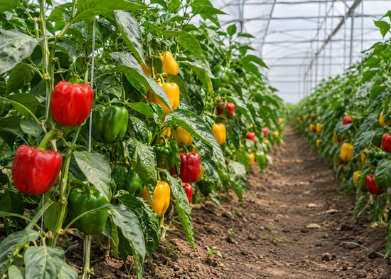
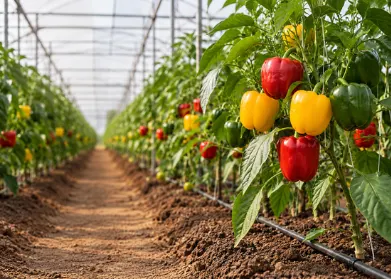
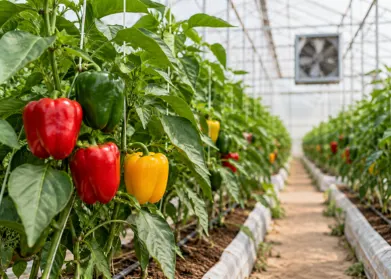
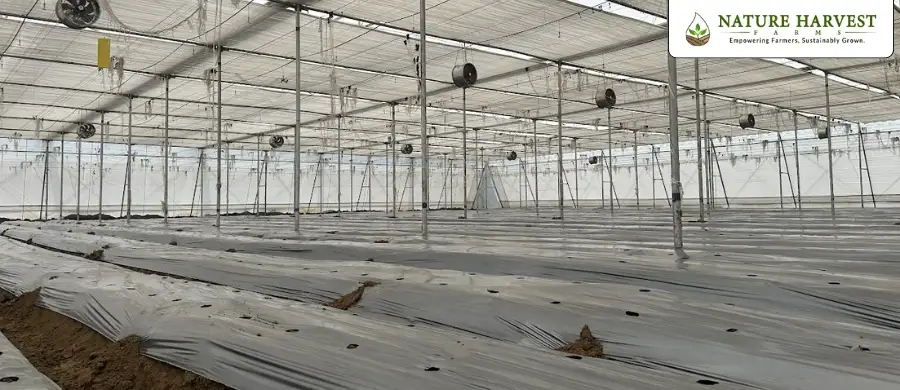
Bell pepper farming in a controlled environment involves growing capsicum while closely managing important growing conditions such as temperature, humidity, irrigation, nutrition, plant health, and protection from extreme external weather. This creates a more stable environment for crop development and helps farmers achieve better consistency in fruit quality and commercial supply.
For businesses purchasing vegetables in bulk, controlled environment farming can offer an important advantage: greater predictability compared with crops exposed entirely to changing open-field conditions.
What Is a Controlled Environment Bell Pepper Farming?
Controlled Environment Agriculture (CEA) is a modern farming approach in which important conditions affecting plant growth are carefully monitored and managed.
Instead of leaving the crop completely dependent on external weather, farmers can create a protected growing environment where factors such as:
- Temperature
- Humidity
- Irrigation
- Plant nutrition
- Light exposure
- Growing conditions
- Pest pressure
- Crop health
can be monitored more closely throughout the crop cycle.
Nature Harvest Farms uses Controlled Environment Agriculture across its farming operations to improve crop consistency and establish a more reliable fresh-produce supply system.
For a crop such as bell pepper, which is sensitive to growing conditions, this controlled approach is particularly valuable.
Why Grow Bell Peppers in a Controlled Environment?
Bell pepper plants require careful management to produce attractive, marketable fruits.
Open-field capsicum farming can be affected by unpredictable weather, excessive heat, rainfall, changing humidity, pests, inconsistent irrigation, and fluctuations in growing conditions.
Controlled farming reduces some of this uncertainty.
Major benefits include:
More consistent growing conditions
Plants develop in a managed environment rather than being completely exposed to changing weather.
Improved crop quality
Closer control over plant health and growing conditions supports better fruit development.
Greater uniformity
Commercial buyers often prefer vegetables with relatively consistent appearance, size, firmness, and quality.
Reduced weather-related crop stress
Protected cultivation creates a buffer against many external environmental changes.
Better supply planning
More predictable crop development helps farms plan harvesting and commercial supply more efficiently.
These benefits make controlled environment bell pepper farming particularly suitable for supplying restaurants, hotels, caterers, wholesalers, and other businesses that require reliable vegetable sourcing.
Bell Pepper Plantation: Where the Crop Journey Begins
Producing premium bell peppers starts long before harvesting.
Successful commercial cultivation requires careful planning during the plantation stage because early plant establishment influences later growth, flowering, fruit development, quality, and productivity.
At Nature Harvest Farms, bell pepper production follows a systematic crop-management approach designed around both plant health and commercial market requirements.
1. Selecting Quality Bell Pepper Plants
Healthy plant material provides the foundation for a productive crop.
The objective is to begin with vigorous plants capable of developing strong root systems and supporting multiple healthy fruits throughout the growing cycle.
Plant selection also depends on the type of bell pepper being cultivated and the target market.
Commercial buyers may require:
- Green bell peppers
- Red bell peppers
- Yellow bell peppers
- Coloured capsicum
- Specific size grades
- Particular maturity stages
Understanding market demand before planting helps align production with actual buyer requirements.
2. Preparing the Controlled Growing Environment
Before plantation, the growing environment must be prepared properly.
The objective is to create favourable conditions for root development, plant establishment, vegetative growth, flowering, and fruit production.
Important environmental parameters are monitored throughout the production cycle so plants experience fewer extreme fluctuations.
Controlled farming does not mean plants grow automatically. It requires continuous observation and crop management.
3. Bell Pepper Plantation
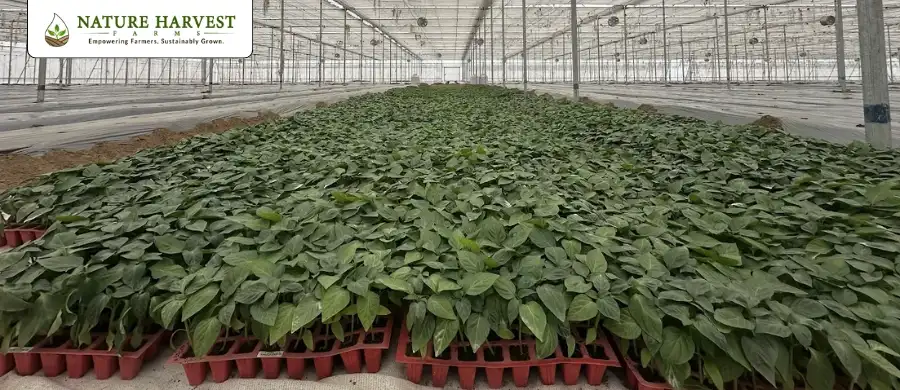
Once the environment is ready, bell pepper plants are transplanted into the designated growing area.
Proper spacing is important because each plant requires sufficient room for:
- Root development
- Leaf growth
- Air circulation
- Light exposure
- Flowering
- Fruit development
- Farm operations and harvesting
Correct plantation density also helps farmers manage the crop more efficiently as the plants mature.
What Happens During the First Month After Bell Pepper Plantation?
The initial growth stage is focused primarily on plant establishment.
During this period, farmers monitor whether plants are adapting properly to their growing environment.
Strong early development is important because the plant later needs enough vegetative strength to support flowering and multiple bell peppers.
Key activities during this stage include:
- Monitoring plant establishment
- Managing irrigation
- Supplying appropriate nutrition
- Observing leaf and stem development
- Monitoring environmental conditions
- Checking for signs of pests or plant stress
- Maintaining healthy growing conditions
Instead of reacting after problems become serious, controlled environment farming makes regular crop observation an important part of daily farm management.
Month Two: Flowering and Early Bell Pepper Development
As the plants mature, they begin transitioning toward flowering and fruit formation.
This stage is particularly important because plant health, environmental conditions, nutrition, and crop management directly influence the development of bell peppers.
Flowers that successfully develop into fruits begin forming small peppers, which gradually increase in size.
During this phase, farmers closely observe:
- Flower development
- Fruit setting
- Plant vigour
- Irrigation requirements
- Nutrition
- Environmental conditions
- Crop health
Maintaining balanced conditions becomes important because major plant stress during flowering and fruit development can affect commercial quality.
Month Three: Bell Peppers Move Toward Market-Ready Harvest
Around the third month after plantation, depending on the variety, crop conditions, production system, and desired harvest stage, bell peppers can begin reaching a commercially harvestable stage.
This is when the plantation begins transitioning from primarily crop development toward harvest and market supply.
However, not every bell pepper on every plant becomes ready simultaneously.
Bell pepper harvesting is generally selective.
Farm teams identify fruits that meet suitable market requirements based on factors such as:
- Size
- Colour
- Firmness
- Maturity
- Shape
- Surface quality
- Buyer specifications
This selective approach allows the farm to supply suitable produce while allowing remaining fruits additional time to develop.
How Long Does Bell Pepper Take From Plantation to Harvest?
For our current cultivation planning, the first bell pepper harvest is expected approximately three months after plantation, although the exact timing can vary with variety, crop stage, environmental conditions, and the maturity specification required by the buyer.
Bell peppers harvested green may reach the required commercial stage earlier than peppers that are allowed to develop their mature red, yellow, or other varietal colour.
Therefore, commercial harvesting is better understood as a harvest window rather than one single harvest date.
Bell Pepper Growth Timeline at a Glance
| Crop Stage | Approximate Activity |
|---|---|
| Plantation | Bell pepper plants are established |
| Month 1 | Root and vegetative development |
| Month 2 | Flowering and early fruit formation |
| Around Month 3 | Bell peppers begin reaching harvest-ready stage |
| After first harvest | Selective harvesting continues according to crop development |
This production cycle helps us plan future bulk availability for commercial vegetable buyers.
Why Bell Pepper Quality Matters for HoReCa Buyers
For a household consumer, purchasing a few bell peppers is simple.
For a hotel, restaurant, café, cloud kitchen, catering company, institutional kitchen, or food-service distributor, procurement is much more demanding.
A HoReCa buyer may require substantial quantities regularly.
Quality inconsistency can create issues with:
- Kitchen preparation
- Food presentation
- Recipe standardisation
- Portion control
- Inventory planning
- Procurement costs
- Storage
- Food waste
This is why commercial food businesses often look beyond price alone.
They need a supplier capable of providing fresh bell peppers in bulk with dependable quality and supply communication.
Nature Harvest Farms broader CEA model is designed around reliable bulk supply for HoReCa, wholesale, and institutional buyers.
What Makes Bell Peppers Suitable for HoReCa?
Bell peppers are widely used across professional kitchens because of their versatility.
They can be used in:
- Salads
- Pizza toppings
- Pasta dishes
- Sandwiches
- Wraps
- Stir-fries
- Grilled dishes
- Asian cuisine
- Continental cuisine
- Mexican dishes
- Indian dishes
- Stuffed pepper recipes
- Catering platters
- Sauces
- Ready-to-eat foods
Different colours also help chefs enhance the visual appeal of dishes.
For restaurants and catering businesses, this creates ongoing demand for fresh green, red, yellow, and coloured bell peppers.
Fresh Bell Peppers for Bulk Orders
Once the crop reaches the appropriate maturity stage, our focus shifts from farming to commercial fulfilment.
Bell peppers intended for B2B supply must be handled with attention because commercial buyers expect freshness and consistency.
The general post-harvest process includes:
Harvesting
Market-ready bell peppers are selected and carefully harvested.
Quality Checking
Produce is examined according to expected market standards.
Sorting
Bell peppers can be separated according to relevant commercial characteristics such as size, colour, or maturity.
Order Planning
Quantities are aligned with confirmed buyer requirements and available harvest volumes.
Bulk Supply
Produce is prepared for HoReCa, wholesale, institutional, or vegetable-market requirements.
At Nature Harvest Farms, our objective is not simply to grow vegetables. We aim to develop a reliable farm-to-business supply system.
Bell Pepper Bulk Supply for HoReCa
HoReCa stands for:
Ho – Hotels
Re – Restaurants
Ca – Cafés/Catering
These businesses frequently purchase vegetables in larger quantities than individual consumers.
Their procurement priorities can include:
- Reliable availability
- Freshness
- Consistent quality
- Uniform produce
- Planned quantities
- Competitive commercial sourcing
- Regular supply
- Efficient communication with suppliers
Our controlled farming approach supports the kind of consistency required for these B2B relationships.
Who Can Buy Bell Peppers in Bulk?
Nature Harvest Farms can serve commercial demand from:
- Hotels
- Restaurants
- Cafés
- Caterers
- Cloud kitchens
- Institutional kitchens
- Food processors
- Vegetable wholesalers
- Retail vegetable businesses
- Supermarkets
- Fresh-produce distributors
- Local vegetable markets
Bulk buyers can discuss their required quantities, specifications, location, and supply frequency with our team.
Bell Pepper Supply for Wholesale Vegetable Markets
Traditional wholesale and vegetable markets continue to play an important role in fresh-produce distribution.
They connect farms with:
- Retail vegetable vendors
- Grocery stores
- Local retailers
- Restaurants
- Smaller wholesalers
- Food businesses
- End consumers
For these markets, reliable volumes and quality are essential.
Controlled farming can help create a more predictable crop pipeline, allowing harvested bell peppers to move efficiently from the farm into commercial distribution channels.
Controlled Environment Farming vs Open-Field Bell Pepper Farming
Both farming systems can produce bell peppers, but they operate very differently.
| Factor | Controlled Environment Farming | Open-Field Farming |
|---|---|---|
| Environmental management | Closely monitored | Strongly weather dependent |
| Protection from extreme weather | Higher | Lower |
| Irrigation management | More precise | Can vary |
| Crop monitoring | Systematic | Depends on farm practices |
| Quality consistency | Potentially higher | Greater variation possible |
| Supply planning | More predictable | More weather dependent |
| Resource optimisation | Greater control possible | More variable |
Controlled Environment Agriculture does not eliminate agricultural risk. Plants remain biological systems that require skill, monitoring, and appropriate management.
However, greater control helps growers reduce some of the unpredictability associated with conventional open-field production.
Water-Efficient Bell Pepper Cultivation
Water efficiency is one of the major reasons modern agriculture is moving toward controlled and precision-based farming.
Instead of applying water broadly across a field, controlled systems can supply water more precisely according to crop requirements.
This helps:
- Reduce unnecessary water loss
- Maintain more stable root-zone conditions
- Improve resource efficiency
- Support uniform crop development
- Make irrigation easier to monitor
Nature Harvest Farms positions sustainability and efficient resource use as core parts of its Controlled Environment Agriculture model.
How Controlled Farming Supports Consistent Bell Pepper Quality
Consistency is one of the most important requirements for commercial vegetable buyers.
Imagine a restaurant ordering bell peppers every week.
If one delivery contains firm, uniform peppers but the next contains dramatically different sizes or quality, kitchen operations become less predictable.
Controlled Environment Agriculture helps reduce such variations by giving farmers more control over the crop’s growing conditions.
That can contribute to bell peppers with more consistent:
- Shape
- Firmness
- Appearance
- Size
- Colour development
- Freshness
- Overall commercial quality
For B2B buyers, this consistency can be just as valuable as total production volume.
From Bell Pepper Plantation to B2B Supply: The Complete Journey
The commercial bell pepper journey can be summarised in seven stages:
1. Crop Planning
Variety, expected demand, growing schedule, and commercial requirements are evaluated.
2. Plantation
Healthy bell pepper plants are established in the controlled farming environment.
3. Vegetative Growth
The plants establish roots and develop healthy foliage and stems.
4. Flowering and Fruit Setting
Flowers develop and begin forming bell peppers.
5. Fruit Development
The peppers grow toward the size, colour, and maturity required by the market.
6. Harvesting and Sorting
Market-ready bell peppers are selectively harvested and checked.
7. Bulk Market Supply
Fresh produce becomes available for HoReCa businesses, wholesalers, institutional buyers, distributors, and vegetable markets.
This farm-to-market approach connects precision agriculture directly with commercial food demand.
Why Bulk Buyers Are Looking at Controlled Environment Farms
Fresh-produce procurement is gradually becoming more organised.
Many professional buyers no longer want to depend entirely on unpredictable spot purchases.
They increasingly value relationships with farms and suppliers that can offer:
Supply visibility
Knowing what crops are being grown and when harvest is expected helps procurement planning.
Quality consistency
Standardised produce simplifies kitchen and retail operations.
Direct sourcing opportunities
A stronger farm-to-buyer connection can make supply chains more transparent.
Planned bulk quantities
Commercial farms can coordinate production and harvesting around B2B demand.
Traceability
Understanding where and how vegetables are cultivated can strengthen buyer confidence.
Nature Harvest Farms’ farming model is designed with these commercial requirements in mind.
Why Nature Harvest Farms Is Growing Bell Peppers
Bell pepper represents exactly the type of crop where modern controlled farming and organised commercial demand can work together.
Our goal is to combine:
- Controlled Environment Agriculture
- Precision crop management
- Sustainable cultivation
- Quality-focused harvesting
- Resource-efficient farming
- Reliable B2B market connections
to build a more dependable fresh-produce supply chain.
As our bell pepper plantation progresses toward harvest, we are preparing to connect upcoming production with HoReCa buyers, wholesale vegetable buyers, institutional kitchens, distributors, and fresh vegetable markets.
Looking for Bell Peppers in Bulk?
Businesses planning regular or bulk bell pepper purchases can connect with Nature Harvest Farms to discuss upcoming harvest availability.
Whether you operate a:
- Restaurant
- Hotel
- Catering company
- Cloud kitchen
- Institutional kitchen
- Vegetable wholesale business
- Supermarket
- Fresh-produce distribution business
- Vegetable retail network
Our team can discuss your expected quantity, preferred bell pepper type, delivery location, and purchasing requirements.
Planning requirements in advance can also help align buyer demand with upcoming harvest volumes.
Bulk Bell Pepper Orders for HoReCa & Wholesale Markets
If your business regularly requires fresh bell peppers, establishing a direct commercial supply relationship can help improve procurement planning.
Nature Harvest Farms is developing its bell pepper crop through Controlled Environment Agriculture with a focus on quality cultivation and organised bulk supply.
Enquire About Bulk Bell Pepper Supply
FAQs
How long does bell pepper take to grow after plantation?
What is controlled environment bell pepper farming?
Is bell pepper the same as capsicum?
Can bell peppers be grown in controlled environments?
Why is controlled environment farming suitable for bell peppers?
Does Nature Harvest Farms supply bell peppers in bulk?
Can restaurants order bell peppers directly in bulk?
Who can purchase bulk capsicum?
Are green and coloured bell peppers harvested at the same stage?
Why should HoReCa buyers source bell peppers from controlled farms?
Conclusion
Bell pepper farming in controlled environments combines modern agricultural technology with careful crop management to create a more predictable path from plantation to harvest. From plant establishment and flowering to fruit development, selective harvesting, sorting, and bulk distribution, every stage contributes to the final quality of the produce.
At Nature Harvest Farms, our bell pepper plantation is part of a larger vision to make fresh-produce farming more sustainable, consistent, and commercially reliable. With the first market-ready harvest planned around approximately three months after plantation under suitable crop conditions, our focus is now moving toward supplying fresh bell peppers to HoReCa businesses, wholesalers, institutional buyers, distributors, and vegetable markets.
For businesses looking for a dependable bulk bell pepper supplier, planning procurement before harvest can create a stronger connection between farm production and market demand.
Grow Better. Harvest Fresh. Supply Smarter.